 By
By MIDRAND, SOUTH AFRICA — In a direct challenge to centuries-old colonial trading patterns, South African President Cyril Ramaphosa has called for a fundamental restructuring of economic relations with Zimbabwe, urging business leaders to move beyond simple cross-border trade toward integrated, cross-border manufacturing and resource beneficiation.

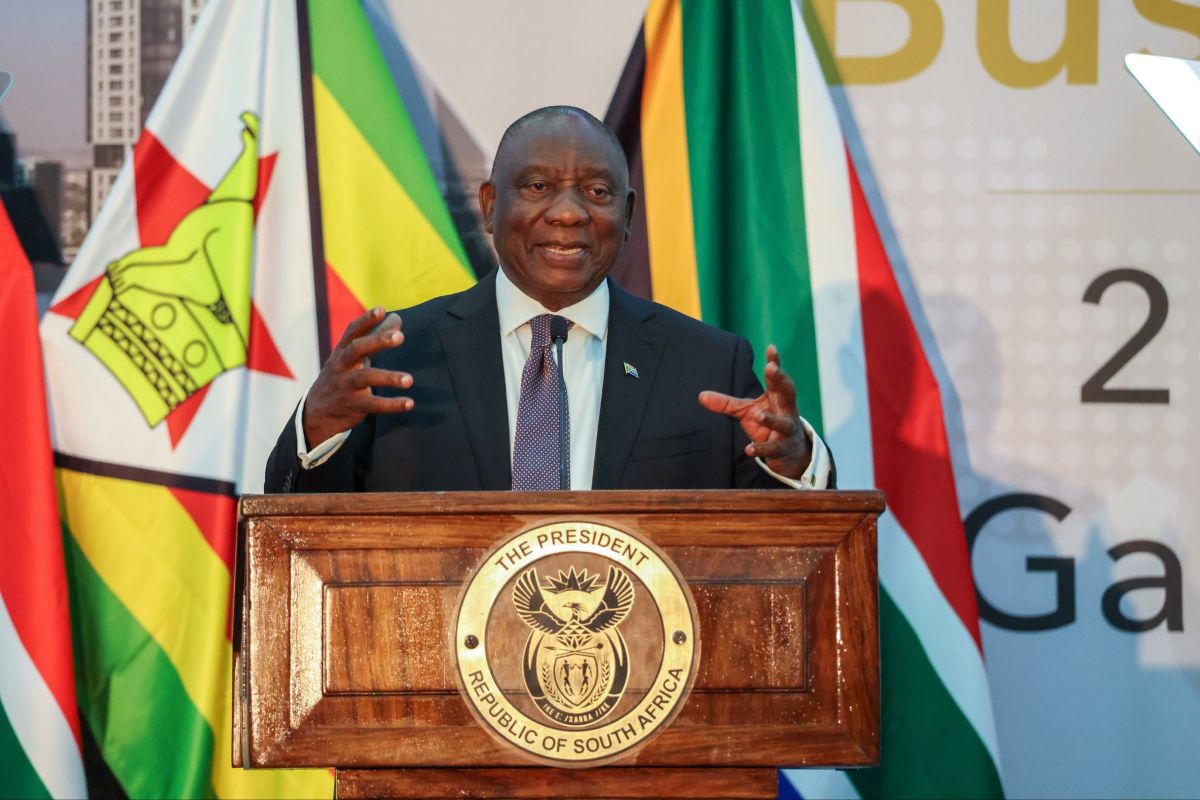
Addressing delegates at the South Africa–Zimbabwe Bi-National Commission (BNC) Business Forum at the Gallagher Convention Centre in Midrand on Friday, 21 August 2026, Ramaphosa highlighted the stark asymmetry defining the bilateral relationship and presented a bold blueprint for shared industrial growth.
The Business Forum coincided with a pivotal week for regional diplomacy, following the 46th Ordinary SADC Summit of Heads of State and Government, where Zimbabwe officially handed the SADC Chairship over to South Africa.
Redressing the Trade Imbalance
While celebrating bilateral trade figures that reached R81 billion in 2025—nearly doubling the volume recorded in 2021—Ramaphosa highlighted an underlying structural deficit that continues to hamper regional development.
Currently, South Africa exports roughly eight times more in value to Zimbabwe than it imports. Furthermore, the nature of the traded goods reflects an out-dated economic paradigm: finished goods such as vehicles, mining machinery, and industrial equipment flow north, while raw commodities, including chromium ore, gold, coal, semi-finished steel, and raw tobacco, travel south.
“This pattern—of finished goods flowing one way and raw commodities flowing the other—has been an impediment to the economic development of our continent for centuries,” Ramaphosa declared. “Through the African Continental Free Trade Area (AfCFTA), we can expand trade between African countries, put our natural resources to better use, develop our industries, and create more jobs for our people.”
To rectify this, Ramaphosa urged firms from both nations to form joint ventures, leveraging South African technology and capital alongside Zimbabwean mineral wealth and labour. He pointed to cross-border industrial processing as the essential next step, emphasizing that raw resources mined in the region must be refined and manufactured locally rather than exported unprocessed to global markets.
Economic Stabilization Sparks Investor Confidence
Acknowledging the persistent economic headwinds both nations have faced, Ramaphosa commended Zimbabwean President Emmerson Mnangagwa, who attended the forum, for recent macroeconomic stabilization measures.
Citing African Development Bank estimates, Ramaphosa noted that Zimbabwe’s real GDP growth reached 7.5% in 2025, buoyed by strong performance in agriculture and mining. He also recognized the stabilizing impact of Zimbabwe’s new currency, the Zimbabwe Gold (ZiG), in bringing down inflation.
“South African exporters and investors need predictability to commit capital at scale, and a steadier Zimbabwean economy gives them that,” Ramaphosa stated, reaffirming that South Africa views its northern neighbour as a cornerstone regional market.
Infrastructure and Corridor Development
A primary focus of the presidential address was removing logistical bottlenecks along critical trade routes. The Beitbridge Border Post—historically plagued by severe congestion where freight trucks routinely faced delays of several days—has undergone significant modernization through public-private partnerships.
With dedicated commercial and passenger lanes and updated customs protocols, average truck crossing times have dropped to approximately 14 hours.
Ramaphosa reaffirmed both governments’ commitment to further developments, including:
- The One-Stop Border Post: Streamlining administrative checks into a unified process.
- Special Economic Zones: Expanding the Musina-Makhado Special Economic Zone (SEZ) near Beitbridge to act as a hub for mining beneficiation, agriculture, agro-processing, and packaging.
- Regional Logistics Corridors: Integrating border operations into a master transport artery linking the Port of Durban directly to the Democratic Republic of the Congo (DRC).
A Call to Action for Private Sector Leaders

While outlining the institutional mechanisms already in place—including the bilateral Joint Technical Committee on Trade and Industry and an upcoming Memorandum of Understanding on Economic Cooperation—Ramaphosa reminded delegates that government policy can only create the framework.
“Governments can determine policy, sign agreements, and ratify protocols, but it is business that turns a signed agreement into a shipment, a factory, or a job,” he asserted.
He called on development finance institutions (DFIs) and private investors to channel capital directly into manufacturing capacity, with a deliberate emphasis on creating equitable opportunities for women and youth.
Drawing a parallel between the historical anti-colonial struggle and today’s economic imperatives, Ramaphosa framed commercial integration as a modern act of solidarity.
“In the times of struggle, solidarity meant refuge and resistance. Today, solidarity means jobs, investment, and a trading relationship that benefits both our peoples,” Ramaphosa concluded. “When you rise, we rise. When we prosper, you prosper. Now is the time for cooperation. Now is the time to get to work.”