 By
By South Africa’s industrial landscape is quietly undergoing a structural shift, one rooted deep within the country’s commercial forestry value chains. At the recent 4th national Timber in Construction Conference—hosted under the banner Connected by Timber: From Forests to Future Cities by the University of Pretoria and the Pretoria Institute for Architecture, in partnership with the Department of Trade, Industry and Competition (dtic)—policymakers, industry leaders, and academics converged to chart a new economic course for the built environment.

For an economy grappling with persistent unemployment, a massive housing backlog, and the urgent imperative to decarbonize industrial processes, the timber sector is emerging as a powerful, multi-faceted catalyst.
Aligning Policy with Industrial Strategy
At the heart of this momentum is an ongoing, strategic collaboration between the dtic and stakeholders of the Master Plan for the Commercial Forestry Sector. This alliance is laser-focused on a singular objective: driving economic growth and job creation by accelerating the widespread adoption of timber construction.
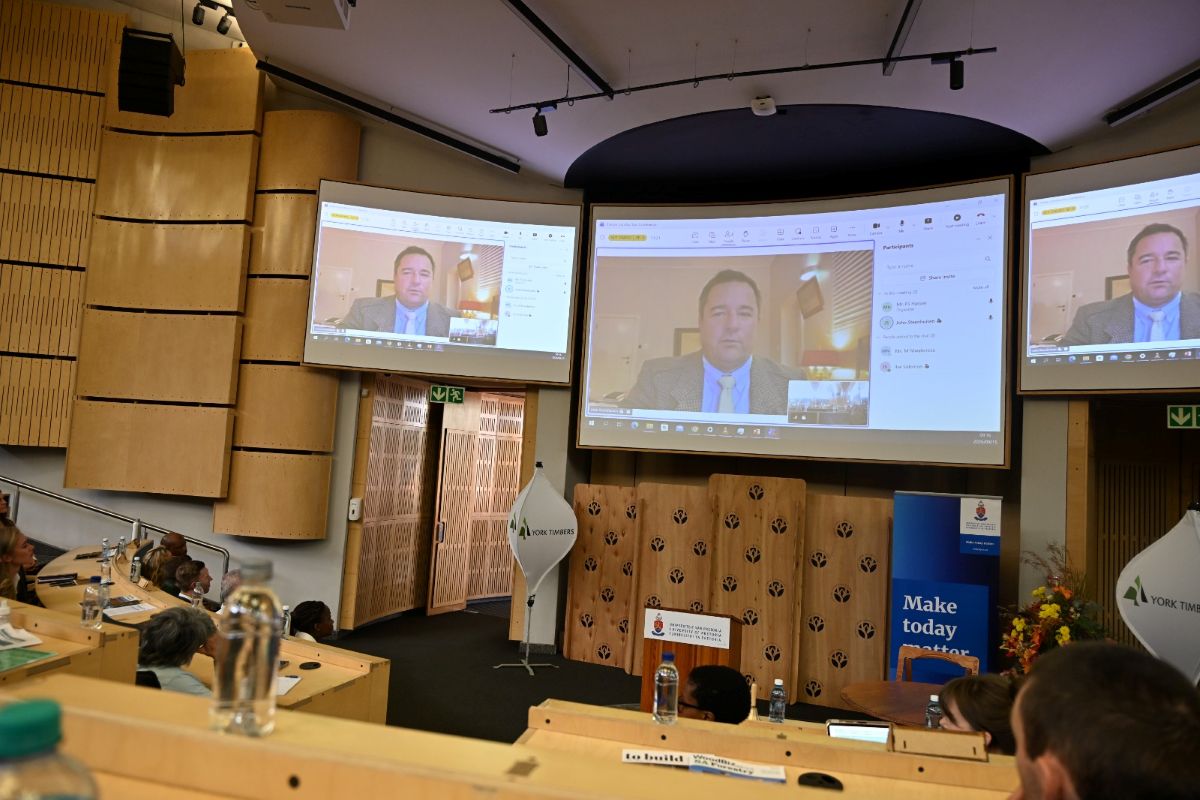
Delivering a keynote address at the conference, Deputy Minister of Trade, Industry and Competition John Steenhuisen emphasized that timber fits squarely into the government’s broader economic modernization blueprint.
“The conference speaks directly to decarbonisation and diversification, which are key pillars of the dtic’s Industrial Development Strategy,” Steenhuisen noted. In economic terms, decarbonisation translates to the substitution of carbon-intensive traditional building materials—such as concrete and steel—with sustainable, renewable alternatives. Simultaneously, diversification expands both domestic market offerings and high-value export streams.
Crucially, the sector’s viability is underpinned by South Africa’s well-established and professional commercial forestry industry. Unlike nascent sectors requiring heavy foundational investment, timber is a reliable, locally available resource capable of supporting immediate commercial scaling.
From Langa to Rosebank: Commercial Viability on Display
Sceptics of timber construction as a mere niche or “eco-friendly novelty” are finding fewer arguments as commercial applications multiply across the country. The conference showcased a diverse portfolio of pioneering projects that prove timber’s economic and structural versatility.
From affordable housing developments in Langa, Cape Town, to multi-storey apartment complexes and commercial structures in Rosebank, Johannesburg, the applications are expanding. High-value tourism infrastructure, such as a five-star hotel in Plettenberg Bay, and large-scale industrial assets—like Premier Foods’ new flour mill in Fort Jackson, Kugompo City—demonstrate that timber can successfully compete across diverse asset classes.
According to industry metrics highlighted at the conference, modular and prefabricated components manufactured from sustainable wood significantly compress project timelines and reduce overhead costs. In a developing economy facing constrained capital budgets and critical housing deficits, these efficiency gains are paramount.
Bridging Gaps: Research, Skills, and Localization
Despite clear momentum, unlocking the sector’s full economic potential requires targeted interventions. Steenhuisen pointed out critical gaps in skills, public education, and technical data for modern engineered wood products, urging that timber must achieve parity with traditional brick-and-mortar methods in the minds of consumers, regulators, and developers.
To bridge these gaps, South African universities are being called upon to aggressively scale up research capacity in wood-based building materials. The goal is to marry international best practices with localized research and development to solve uniquely South African infrastructure challenges.
This vision requires an integrated policy framework—one that harmonizes wood science, structural engineering, and public policy to maximize environmental outcomes while lowering barriers to entry for architects, design schools, and civil engineers.
Strengthening Industry-Academia Synergies
A tangible highlight of the conference was the reinforcement of long-standing institutional partnerships. The University of Pretoria and York Timbers officially signed a long-term extension of their collaborative agreement, centred around the York Timbers Chair in Wood Structural Engineering, held by Professor Schalk Grobbelaar.
Grobbelaar emphasized that the synergy between forestry, science, and industry is creating an unstoppable movement. “We are seeing students, researchers, foresters, saw millers, engineers, architects, builders, government, and international partners start to pull in the same direction,” he remarked. “We want to keep pushing the limits of what timber can do… and show that innovation can create value for industry, while also making a positive contribution to people and the environment.”
Echoing this sentiment, York Timbers CEO Schalk Barnard tied the partnership directly to the company’s long-term corporate strategy: extracting maximum economic value from South Africa’s renewable timber resources.
The Economic Horizon
As South Africa looks toward a post-carbon industrial future, the timber sector offers a compelling template for economic renewal. By transforming raw, renewable forestry assets into advanced engineered building solutions, the country is not only addressing its infrastructure and housing deficits, but also creating sustainable, high-skill employment along the entire value chain.
From forest floor to skyline, timber is proving that economic growth and environmental stewardship are not mutually exclusive—they are structurally interdependent.