
 By
By 
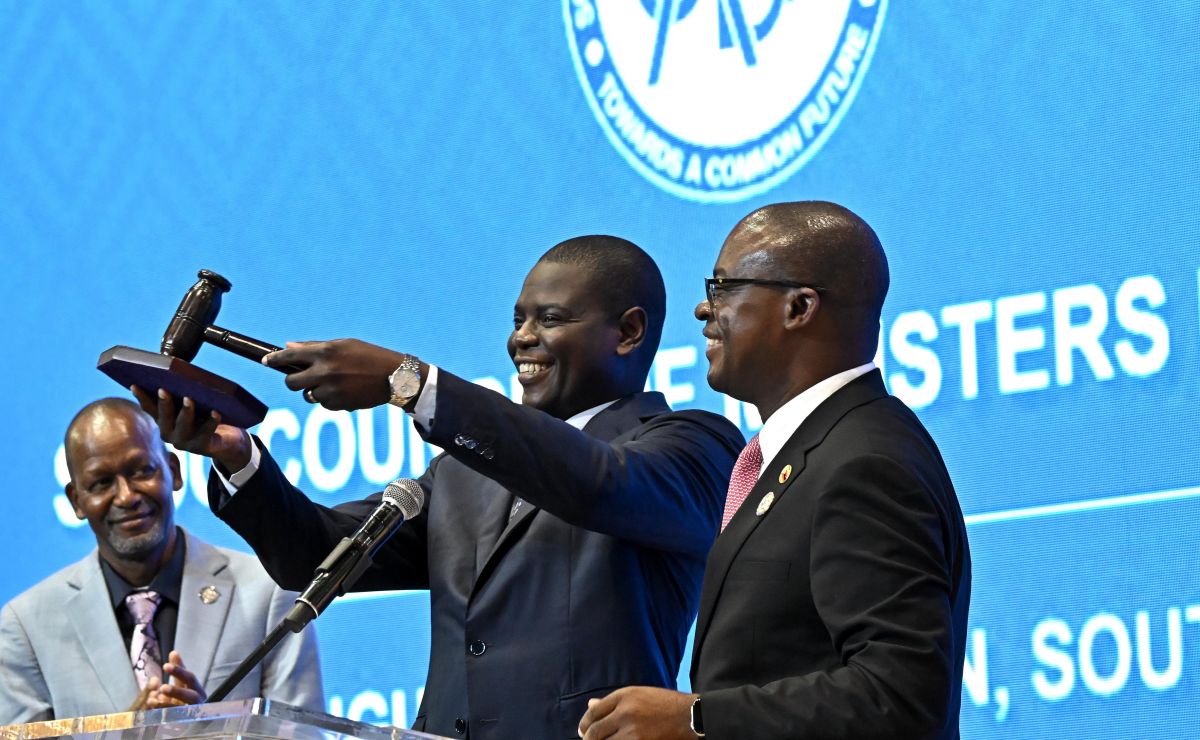
DURBAN — Positioning regional economic integration and sovereign resource control as urgent historic imperatives, South Africa’s Minister of International Relations and Cooperation, Ronald O. Lamola, officially accepted the Southern African Development Community (SADC) Chairpersonship for 2026–2027 on Wednesday, August 12, 2026.
Delivering his acceptance speech and opening remarks at the SADC Council of Ministers at the Inkosi Albert Luthuli International Convention Centre in Durban, Lamola outlined an ambitious agenda focused on critical minerals beneficiation, infrastructure expansion, and regularised human mobility across Southern Africa.
South Africa assumes the rotating leadership from the Republic of Zimbabwe, with the Republic of Zambia taking over as incoming Chair.
Durban’s Historic Resonance
Reflecting on the location of the Council meeting, Lamola drew explicit connections between Durban’s history and the broader Pan-African trajectory. He invoked the legacy of Inkosi Albert Luthuli—the first African Nobel Peace Prize laureate—whose personal lineage bridged South Africa and Zimbabwe, symbolizing the deep-seated cross-border solidarity of the SADC region long before formal integration mechanisms existed.
“His journey reminds us that the histories of our countries are intertwined,” Lamola stated, further recalling that the Durban venue previously hosted the landmark UN World Conference Against Racism in 2001 and the transition of the Organisation of African Unity (OAU) into the African Union (AU) in July 2002.
Lamola urged ministers to leverage these historic milestones to tackle contemporary geopolitical shifts, economic fragmentation, and climate disruptions.
======================================================================== SADC AT A GLANCE: KEY METRICS ======================================================================== • Intra-SADC Trade Level: 20% (Target: 50%) • Untapped Intra-Africa Trade Potential: $84 Billion (SADC Share: $53B) • Manufacturing Share of SADC GDP: 10% • Continental Median Age: 19 Years • Global Share of Critical Minerals: ~30% Proven Reserves • Global Share of Cobalt / Graphite: ~50% Cobalt / ~20% Graphite ========================================================================Unlocking Industrial Value Chains and Critical Minerals
Central to Pretoria’s strategic agenda under President Cyril Ramaphosa is fundamentally altering the region’s extractive economic model.
Lamola highlighted that Southern Africa possesses roughly 30 percent of the planet’s proven critical mineral reserves, including 50 percent of global cobalt reserves and 20 percent of graphite reserves. However, he cautioned that these resources have historically “nourished economies far and wide,” leaving local populations trapped in primary export cycles.
“Reversing this pattern requires us to beneficiate our resources, build regional value chains and trade more with one another,” Lamola urged.
Addressing regional trade barriers, the Minister noted that intra-SADC trade currently sits at a modest 20 percent. Pointing to African Export-Import Bank estimates showing $53 billion in untapped intra-African trade potential within the SADC block alone, Lamola reaffirmed South Africa’s commitment to enforcing the objectives of the Skukuza retreat—specifically targeting a 50 percent intra-SADC trade share alongside mineral processing at origin.
| Strategic Priority Area | Key Objectives & Targets |
| 1. Peace & Security | Sovereign equality, collective security responses, political stability. |
| 2. Trade & Beneficiation | Drive intra-SADC trade to 50%; local mineral processing ($53B untapped capacity). |
| 3. Infrastructure Development | Modernise ports, digital networks, regional energy grids, transport corridors. |
| 4. Human Capital & Mobility | Youth empowerment, gender equality, signature of SADC Free Movement Protocol. |
Modernising Regional Infrastructure
To support industrialization—which currently generates only 10 percent of regional GDP—Lamola called for immediate investments in cross-border infrastructure. Strategic focus areas for the 2026–2027 term will include:
- Upgrading regional transport corridors, commercial ports, and water supply networks.
- Expanding digital network integration to facilitate frictionless cross-border services.
- Strengthening interconnected regional energy grids to support heavy manufacturing.
Lamola framed these structural upgrades as crucial for absorbing the continent’s rapidly growing youth demographic. With a median age of 19 and nearly 60 percent of the population under 25, Africa is projected to host one in every four young people globally by 2030. Economic output and job creation must urgently match this demographic momentum.
Addressing Migration and Human Mobility
Addressing domestic and regional debate around population movement, Lamola presented a dual policy stance on migration. While acknowledging South African public concerns regarding irregular migration, pressure on public infrastructure, and border integrity, he firmly condemned vigilantism and civil rights infringements.
“Addressing the challenges associated with irregular migration must occur within an orderly and lawful framework,” Lamola emphasized, highlighting that South Africa’s historical industrial expansion relied heavily on regional labour pools.
To establish long-term stability, South Africa explicitly called on SADC member states to sign and ratify the Protocol on the Free Movement of Persons to promote regularized, legal migration. Lamola commended SADC’s defence of the principle of subsidiarity during recent discussions at the 49th AU Executive Council, insisting that the region most affected must lead policy design.

Global Flux and Regional Mandate
Concluding his address against a backdrop of heightened global power rivalries, protectionism, and severe climate events, Lamola reaffirmed Pretoria’s commitment to advancing the SADC Regional Indicative Strategic Development Plan (RISDP) 2020–2030.
“As Southern Africa’s most industrialised economy, we recognise the duty and obligation to place our capabilities at the service of regional integration and shared prosperity,” Lamola declared.
The Minister closed by extending best wishes to the Republic of Zambia as it prepares to hold general elections on August 13, 2026, underlining democratic stability as the essential foundation for sustainable economic growth across the subcontinent.