 By
By 
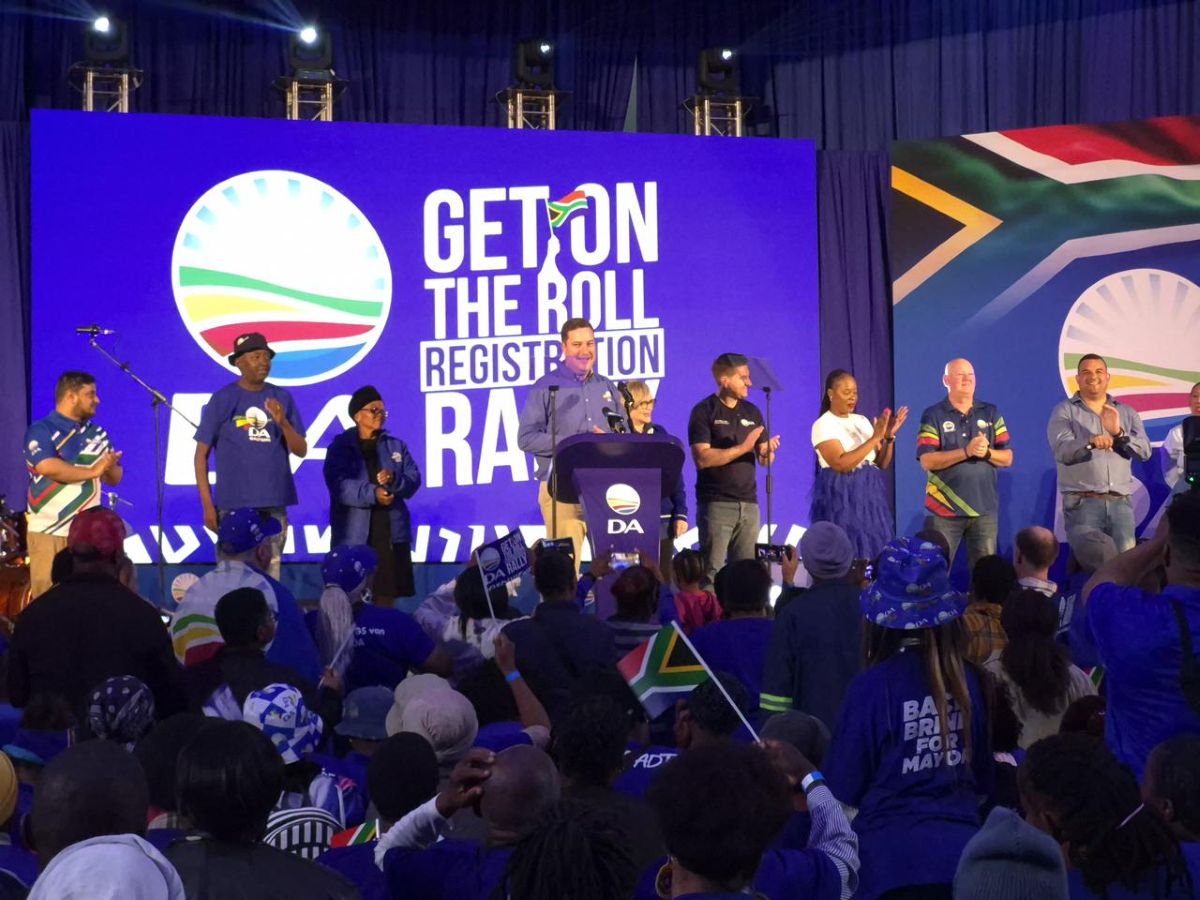
TSHWANE — In a high-energy address that officially shifts South Africa’s political landscape into campaign overdrive, Democratic Alliance (DA) Federal Leader Geordin Hill-Lewis delivered a rallying cry at the party’s “Get On The Roll” Registration Rally in Eersterust. With the 2026 local government elections looming in November, Hill-Lewis positioned the DA as the sole antidote to what he termed “coalition chaos,” weaponizing recent historic municipal breakthroughs and exposing fracturing lines within opposing factions.
A Sensational Shift in the Townships
The atmosphere at the Tshwane rally was unashamedly celebratory, catalyzed by a watershed moment in Gauteng politics earlier in the week. Hill-Lewis recounted waking up to a deluge of messages confirming that the DA had secured a 100% township ward victory in Emfuleni—a historical ANC stronghold where the DA previously commanded a mere 1% of the vote.
Characterizing the triumph in Evaton and Emfuleni as a “truly sensational shift in South African politics,” Hill-Lewis revealed that the political shockwave forced the ANC to immediately ax the Emfuleni Mayor.
“For years Emfuleni has been one of the worst governed municipalities in the whole country,” Hill-Lewis stated, contrasting it directly with the neighboring DA-led Midvaal municipality. “They are panicking. They see the blue wave coming… and it is going to sweep away bad government.”
The DA leader explicitly used this victory to signal to adjacent metros, including Johannesburg, Orange Farm, and Soweto, that long-standing political allegiances are dissolving. The ultimate objective, he noted, is reinstating Cilliers Brink as the Mayor of Tshwane to fix local infrastructure before leveraging that momentum for a march toward the Union Buildings in 2029.
National Security and the Parolee Scandal
Shifting focus from local potholes to national security, Hill-Lewis launched a scathing attack on the current administration’s law and order failures. He brought to light a damning systemic collapse: 28,000 convicted parolees—many of whom are violent criminals, rapists, and murderers—have gone entirely missing from the state’s tracking system.
In a direct political jab at a fellow opposition-turned-governing peer, Hill-Lewis placed the blame squarely on the Minister of Prisons, Pieter Groenewald of the Freedom Front Plus (FF Plus). He criticized Groenewald for allegedly knowing about the crisis for two years without implementing a recovery plan, relying instead on organizing a “summit”.
“FF Plus cannot pretend to be a party of law and order while its own Minister presides over a parole system that has lost track of tens of thousands of violent offenders,” Hill-Lewis charged.
As a countermeasure, Hill-Lewis announced that a DA government would mandate the use of electronic tracking bracelets for all violent parolees, pitching it as a practical, tech-driven solution to safeguard communities.
The Choice: Delivery vs. Coalition Chaos
With the local government elections framed around daily bread-and-butter issues—functioning streetlights, reliable water supply, and well-maintained roads—the DA is drawing a stark line between its governance record and the volatility of multi-party coalitions.
Hill-Lewis took aim at small-party politics, specifically targeting Patriotic Alliance (PA) mayoral candidate Kenny Kunene. He condemned Kunene’s recent disruptive antics in the Johannesburg Council chamber, where Kunene allegedly mimicked firing a machine gun and brandished his belt at DA members. Hill-Lewis warned that “coalition chaos” elevates “thugs” from the PA and EFF, turning vital service delivery budgets into bargaining chips in backroom political deals.
Pointing to the Western Cape’s low unemployment rate and clean audits, Hill-Lewis argued that economic growth and jobs only follow basic municipal competence, not political rhetoric.
The Road to November
The speech concluded with an urgent directive to the party faithful: transition from mere supporters into active registration champions. Emblerishing the reality that elections are won in the registration queues months before the ballots open, Hill-Lewis urged activists to audit their neighborhoods, families, and disillusioned youth.
For the DA, the 2026 local government election is not just a municipal check-in; it is a critical referendum designed to break the back of coalition instability and set a direct trajectory for national power in 2029.