 By
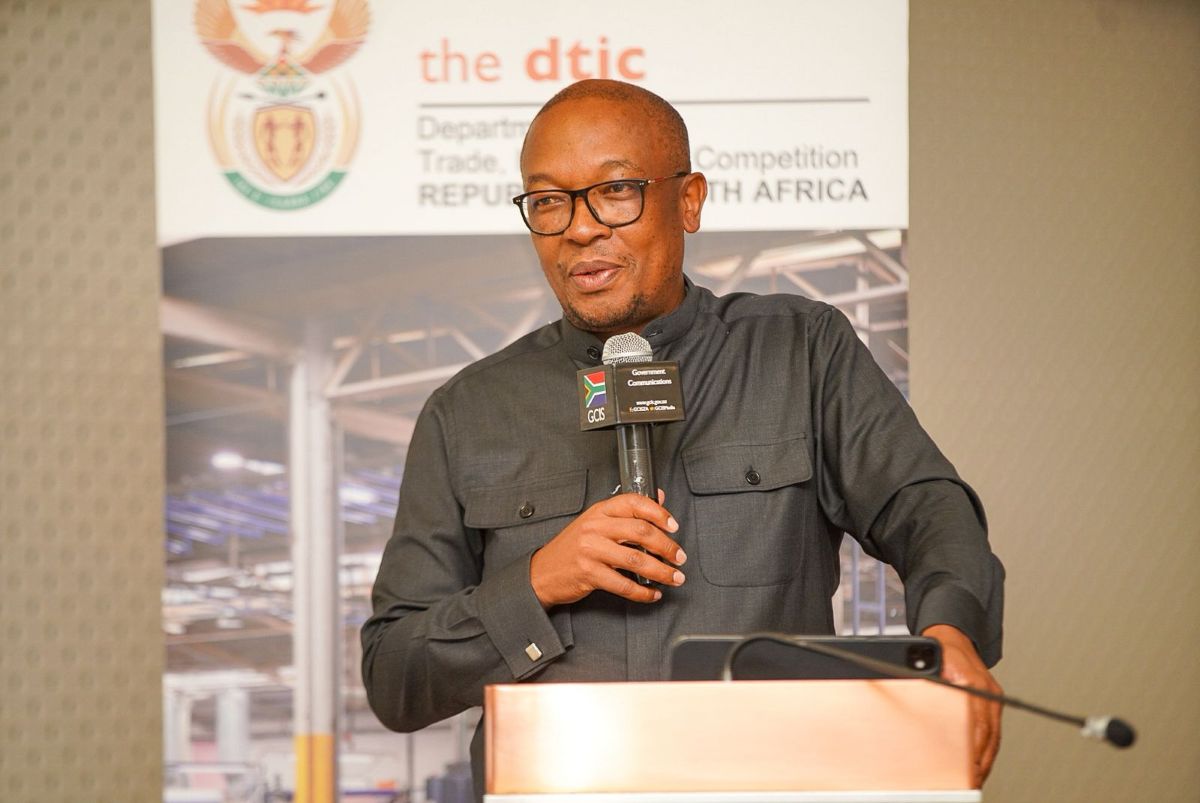
By As South Africa’s manufacturing sector navigates a challenging economic landscape, Minister of Trade, Industry and Competition Parks Tau has stepped up government engagement with key industrial players.
Following site visits to heavy machinery manufacturer Bell Equipment and forestry giant Mondi South Africa in KwaZulu-Natal, the Minister underscored the vital role these industrial anchors play in sustaining local value chains, employment, and export earnings.
A Sector Under Pressure
The ministerial visits arrive at a critical juncture for domestic industry. Fresh data from Statistics South Africa reveals that manufacturing production plummeted by 4.3% in August compared to the same period a year earlier. Output has dropped by 1.7% over the first eight months of 2026, following a 1.3% contraction in 2025.
Overall factory output languishes roughly 10% below 2019 levels, with major manufacturers utilizing only about three-quarters of their operational capacity.
Compounding these struggles, the wood, paper, publishing, and printing division—encompassing Mondi’s operations—has suffered continuous year-on-year contraction for over a year.
“We must be honest about the state of manufacturing in our country. The sector has been in decline, and too many factories have been forced to cut capacity in the face of cheap imports,” Minister Tau stated.
Bell Equipment: A Global Competitor Rooted Locally
Operating out of a sprawling 40 000-square-metre manufacturing facility, Bell Equipment directly employs over 3,000 workers and sources materials from more than 900 local suppliers—over 500 of which are based in KwaZulu-Natal.
The company consumes upwards of 14,000 tons of domestic steel and relies on a team of more than 100 engineers to drive South African intellectual property.
The economic footprint of Bell Equipment is profound. Over the past decade, the firm has:
- Contributed R5 billion to the national fiscus.
- Injected R40 billion into local procurement.
- Disbursed R7 billion in salaries and wages.
- Generated R60 billion in export revenue across 80 countries.
- Trained 550 apprentices.
Looking ahead, Bell outlined ambitious expansion plans centred on its motor grader market, scaling up intellectual property, exploring electric vehicle and defence opportunities, and deepening localization through contract manufacturing.
Management pointed to the success of the Automotive Production and Development Programme (APDP) while requesting further policy support, including expanded incentive access and strengthened preference for locally manufactured goods.
Mondi South Africa: Driving Decarbonisation and Facing Import Floods
At Mondi, Minister Tau evaluated an integrated forestry, pulp, and paper business that employs approximately 1,500 people, supports roughly 10,000 daily livelihoods, and sustains 3,500 rural timber growers. In 2025 alone, the company contributed R737 million in taxes and associated expenditures, yielded R3.4 billion in export revenue, and paid R1.7 billion in employee compensation.
Exceeding its initial R8 billion pledge made at the 2018 South Africa Investment Conference, Mondi has approved R14 billion in investments. Among these is Project Vuselela, a R3 billion biomass boiler in Richards Bay scheduled for commissioning in June 2027.
This initiative will replace three coal-fired units, slash carbon dioxide emissions by 350,000 tonnes annually, reduce coal-derived greenhouse gas emissions by 92%, and incorporate over 3,800 small-scale timber growers—62% of which are women-led enterprises.
However, Mondi faces intense headwinds from surging foreign competition. Imports of locally produced bleached pulp, containerboard, and uncoated fine paper nearly doubled between 2023 and 2025, climbing from roughly 105,500 tonnes to nearly 210,000 tonnes, with first-half 2026 imports rising another 19% year-on-year.
“The pulp and paper sector contributes R55 billion to the economy and supports around 150 000 jobs. We cannot allow surging imports to hollow it out,” Minister Tau emphasized, noting that trade remedy applications will be processed rigorously through the Department of Trade, Industry and Competition (the dtic).
Minister Tau’s regional program concludes with a business engagement hosted by the Zululand Chamber of Commerce and Industry (ZCCI), focusing on how smaller enterprises can integrate into the growth networks of anchor manufacturers to collectively reverse industrial decline.