 By
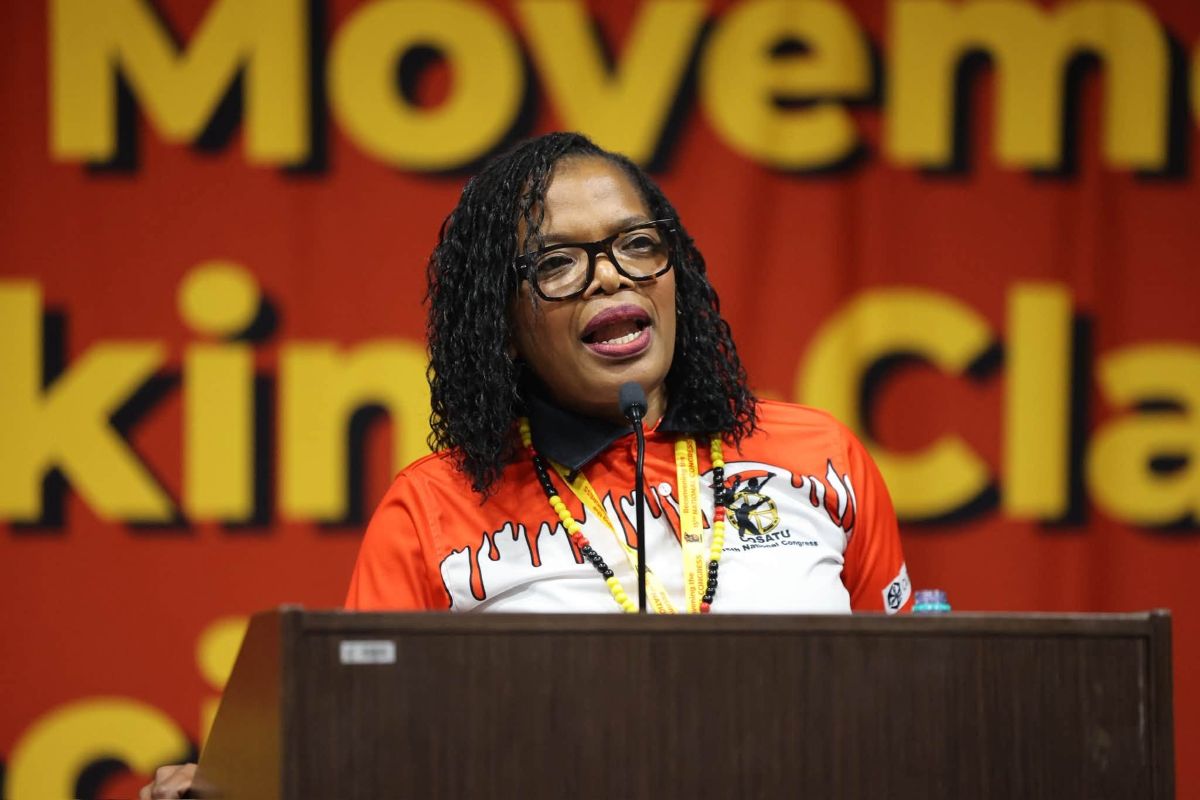
By Opening the 15th National Congress of the Congress of South African Trade Unions (COSATU), President Zingiswa Losi delivered a crucial address to delegates, alliance partners, and working-class representatives.
Against the backdrop of recent internal tensions and an adjourned initial sitting, Losi called on the federation to step back from factional divisions and recommit to defending worker rights, confronting socio-economic distress, and advancing the National Democratic Revolution.
Rising Above Division to Reclaim Working-Class Leadership
Losi acknowledged the deep discomfort surrounding the federation’s recent organizational setbacks, noting that the spectacle of an adjourned congress was an embarrassing chapter in COSATU’s 40-year history.
Warning delegates against the dangers of factionalism, litigation, and internal destruction, she stressed that internal division weakens the labour movement, demoralizes workers, and emboldens class enemies.
Invoking the warnings of the September Commission, Losi warned against allowing COSATU to deteriorate into a “Skoro Skoro”. She urged the collective leadership and membership to place the unity of the federation and the interests of the working class above individual ambitions.
Citing Amílcar Cabral, she reminded delegates that working-class struggles are fundamentally about material benefits, improved livelihoods, and securing a better future for the next generation.
Celebrating Key Gains: Minimum Wage, Two-Pot Reforms, and Eskom
Despite recent internal friction, Losi highlighted significant socio-economic policy victories achieved by COSATU over the past four years:
- Labour Law & Policy Gains: At Nedlac in 2022, COSATU blocked attempts to roll back worker rights, while securing agreements to double retrenchment payments, protect the National Minimum Wage from deductions, enforce equal pay for equal work, and extend collective bargaining rights to platform workers, artists, and actors.
- National Minimum Wage Impact: Since its introduction in 2019, the National Minimum Wage has driven wage increases of 100% for over 800,000 domestic workers, 66% for 900,000 farmworkers, and 50% for more than 4 million vulnerable workers in sectors such as hospitality, security, cleaning, and construction.
- Corporate Wage Transparency: Amendments to the Companies Act, spearheaded alongside former DTIC Minister Ebrahim Patel, now mandate listed and state-owned enterprises to disclose executive pay ratios, driving major financial and retail firms to raise base wages.
- Two-Pot Pension System: Implemented in 2024 after four years of lobbying, the reforms have released over R80 billion to more than 4 million indebted workers while strengthening long-term savings.
- Stabilizing Eskom: Losi defended COSATU’s proposal for the R253 billion Eskom Debt Relief Package, crediting energy sector workers for mitigating load-shedding while reaffirming opposition to the privatization or unbundling of the power utility.
Macroeconomic Demands and Public Sector Protections
Looking ahead to the upcoming Medium-Term Budget Policy Statement (MTBPS), Losi rejected neo-liberal policies and austerity measures. Emphasizing that South Africa cannot normalize a 43.8% unemployment rate, she demanded a bold stimulus package to break the current “investment strike” and expand public employment programmes.
While welcoming the recruitment of 10,000 police officers, 10,000 labour inspectors, and 6,500 South African Revenue Service (SARS) personnel, Losi called for further public sector expansion in health, education, and municipal services. She condemned non-paying employers and local governments that fail to pay municipal workers on time or unlawfully withhold pension contributions, demanding criminal prosecution for defaulting employers.
International Solidarity and Regional Integration
Positioning COSATU within the global anti-imperialist movement, Losi expressed solidarity with struggles in Palestine, Cuba, Western Sahara, Venezuela, eSwatini, and Afghanistan. She condemned right-wing chauvinism and xenophobia, calling for deeper pan-African economic cooperation through the African Continental Free Trade Area (AfCFTA) to address the root causes of forced migration and poverty across the continent.
Rebuilding the Tripartite Alliance Ahead of Elections
Addressing the Tripartite Alliance, Losi referenced Nelson Mandela’s historical assessment of the symbiotic relationship between the ANC, SACP, and COSATU. Reaffirming COSATU’s commitment to the Alliance, she emphasized the mandate to convene the Alliance Political Council, resolve internal differences, and mobilize a unified electoral campaign for the upcoming elections on November 4.
Growth Target: Reaching Two Million Members
To ensure the federation’s long-term sustainability, Losi outlined an ambitious organizational drive:
- Expanding Scope: Intensifying recruitment across non-traditional sectors, including call centres, restaurants, farms, e-hailing, and informal taxi ranks.
- Membership Goals: Reaching 1.6 million members by the end of 2026, with a target of 2 million members by the 16th National Congress.
- Unifying the Trade Union Movement: Calling on former affiliates—including NUMSA, FAWU, and SAFPU—to return to COSATU under the founding principle of “one industry, one union; one federation, one country”.
Losi concluded by expressing gratitude to the federation’s leadership, affiliate structures, veteran trade unionists, and staff, reaffirming COSATU’s core identity as the defender of the working class and the custodian of the Freedom Charter.