
 By
By 
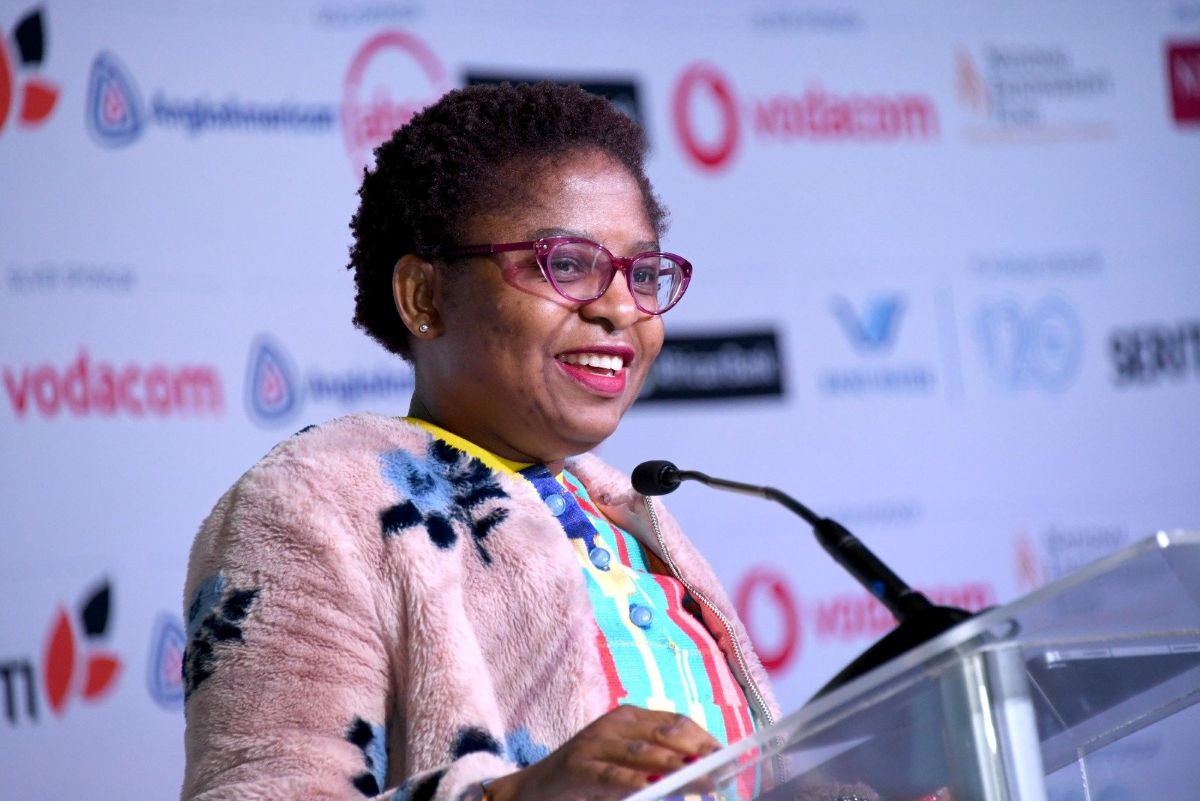
MOSCOW — Against the backdrop of a rapidly fracture-lining global order, South Africa’s Minister in The Presidency, Khumbudzo Ntshavheni, delivered a series of uncompromising addresses at the International Security Forum in Moscow.
Speaking across multiple high-stakes sessions, Ntshavheni laid bare the strategic anxieties and vision of the Global South, positioning Pretoria as a leading voice for a fairer, multipolar international system while taking aim at Western hegemony, vaccine nationalism, and asymmetric information warfare.
The multi-day summit highlighted a profound transformation in how middle powers navigate a world characterized by what Ntshavheni described as “overlapping crises”—ranging from persistent armed conflicts to technological disruptions and escalating climate change. Rather than viewing the transition away from a unipolar system with dread, South Africa firmly defended the rise of multipolarity.
“Multipolarity in itself is not a threat,” Ntshavheni stated, asserting that a fragmented world can be properly managed to create an equitable system where the Global South possesses a stronger, institutional voice. However, she warned that the current transition is marred by heightened strategic rivalry and a deterioration of trust among major powers. “Our message is clear: Multipolarity must not mean multi-conflict or multi-standards,” she emphasized, urging a return to shared responsibility and consistent respect for international law.
Bio-Geopolitics: The Asymmetry of Global Health
Nowhere was the Minister’s critique of the current global architecture sharper than in her analysis of international health cooperation. In the post-COVID-19 era, health response coordination has evolved into an integral pillar of national and international security. Drawing on South Africa’s tenure as the African Union’s COVID-19 champion, Ntshavheni contrasted the theoretical “power of cooperation” with the grim realities of geopolitical selfishness.
The Minister accused the Global North of systemic abandonment and institutional hypocrisy. While the swift development of COVID-19 vaccines proved that global cooperation can resolve endemic crises, the actual distribution exposed deep moral and political fractures. Ntshavheni reminded delegates that Western nations chose to hoard life-saving vaccines for their own populations in “total violation” of World Health Organization (WHO) principles. Furthermore, when developing nations applied for intellectual property patent waivers at the World Trade Organization (WTO) to manufacture their own vaccines, “supposed allies in the global North” actively opposed the applications.
This structural abandonment, South Africa argues, persists today. Pointing to a severe outbreak of Ebola currently ravaging the Central–East Africa region, Ntshavheni noted that the Global North has opted to merely watch from a distance, even going so far as to divert flights carrying passengers from the region. This response comes despite urgent appeals for assistance from the African Union’s Centre for Disease Control (CDC).
In response to Western inaction, South Africa announced a US$5 million pledge directly to the African CDC to combat the Ebola outbreak, challenging the International Security Forum’s delegates to match Pretoria’s financial mobilization.
To permanently insulate health from geopolitical blackmail, South Africa is driving a landmark partnership to establish the continent’s first end-to-end, multi-vaccine production facility via Biovac. Scheduled for completion by 2028, the plant is engineered to produce oral cholera vaccines before expanding to polio, pneumonia, and meningitis, boasting an annual capacity of up to 40 million doses to secure regional supply chains.
The Strait of Hormuz: A “Catastrophic” Digital Warfare Horizon
Shifting to immediate hard-security flashpoints, the forum shed light on a terrifying and highly volatile escalation in the Middle East. As the asymmetric war between Israel and the United States on one side, and Iran on the other, enters its fourth month, the conflict has reached a dangerous diplomatic deadlock.
Despite high-profile assassinations of senior Iranian officials, the joint US-Israeli objective to eliminate Iran’s leadership and force regime change remains unfulfilled due to what Pretoria terms “fierce resistance” that Western intelligence severely underestimated.
While Pakistan-led diplomatic mediation continues intermittently, the conflict’s economic and physical fallout is already disrupting the global economy via a dual naval blockade of the Strait of Hormuz maintained by both Washington and Tehran.
However, South Africa revealed a far more ominous dimension to the standoff: the transition from an energy crisis to a potential global digital catastrophe. Intelligence indicates that Iran plans to expand its leverage in the maritime chokepoint by targeting and disrupting subsea fibre-optic communication cables running through the Strait.
Such targeted sabotage would directly impact multinational tech giants—including Google, Microsoft, Meta, and Amazon—paralyzing global communications, cross-border financial transactions, cloud computing, social media, and e-commerce.
With recurring ceasefire violations and both sides continuously shifting their diplomatic goalposts, the risk of a slide back into full-scale war is high. For South Africa, the domestic consequences are direct, manifesting as soaring energy prices, stubborn inflation, and a severe cost-of-living crisis. Politically, Pretoria reaffirmed its unyielding support for Palestinian statehood within the historic 1967 borders, with East Jerusalem as its capital, alongside Israel.
Hybrid Warfare: Defending Information Sovereignty
Beyond physical battlefields and maritime chokepoints, the Minister focused intensely on the invisible theaters of conflict: digital media and Artificial Intelligence (AI) used as instruments of “hybrid war”. Ntshavheni explicitly accused Western state and non-state actors of using coordinated media campaigns, cyber operations, and targeted online manipulation to maintain systemic hegemony and dictate economic partnerships to the “global majority”.
South Africa itself has become a prime target and terrain for these sophisticated narrative operations. During its national elections, the country faced sustained, organized disinformation campaigns targeting both foreign and domestic policy decisions.
The Minister specifically highlighted the international amplification of the “white genocide” narrative. This campaign, she asserted, radicalizes tragic farm murders to falsely claim a systematic, state-sanctioned extermination of white citizens, fuelled by far-right networks globally.
To protect its “information sovereignty” and maintain social cohesion, Pretoria is enacting a sweeping review of its information and national communication policies. South Africa plans to legally compel global digital platforms to implement strict “AI content branding”—disclosing all AI-generated content they host—and explicitly prohibit the publication of fake or misleading news concerning the Republic.
Domestically, the government is establishing a proactive, state-led Fact-Check capability to debunk deep-fakes and is deploying a “Quick Guide” to train government communicators to aggressively counter misinformation, disinformation, and mal-information (MDM).
The BRICS Nexus: Food, Energy, and a New Global Order
Faced with these multi-directional threats, South Africa views the expanded BRICS bloc not as an adversarial “alternative” to the United Nations, but as an indispensable vehicle to deepen internal alignment among developing nations. The economic weight of the bloc is undeniable: BRICS nations and their new partners control 40-45% of global food production, one-third of the world’s agricultural land, and nearly 40% of global water resources.
This massive footprint makes the bloc a central pillar of global stability at a time when 673 million people worldwide endure chronic hunger, exacerbated by climate shocks and artificial price volatility. South Africa urged the bloc to treat food and energy security as an intertwined strategic nexus. Local crises demonstrate how energy shortages and water stress instantly destroy agricultural output and escalate food prices, disproportionately impacting vulnerable populations.
To counter this, South Africa highlighted its internal models, such as the data-driven Musa Plan to eradicate food poverty, and its Just Energy Transition Investment Plan, which has successfully secured $13.5 billion in international pledges to upgrade its national grid and scale up renewable manufacturing.
Ultimately, South Africa’s message at the Moscow forum was an assertion of agency. By leveraging platforms like BRICS, pushing for regional vaccine independence, and legislating against external digital manipulation, Pretoria is actively refusing to allow the African continent to become collateral damage in a great-power competition. The unfolding multipolar world must be bound by rules, or it risks degenerating into an era of structural conflict where the global majority once again pays the ultimate price.