
 By
By 
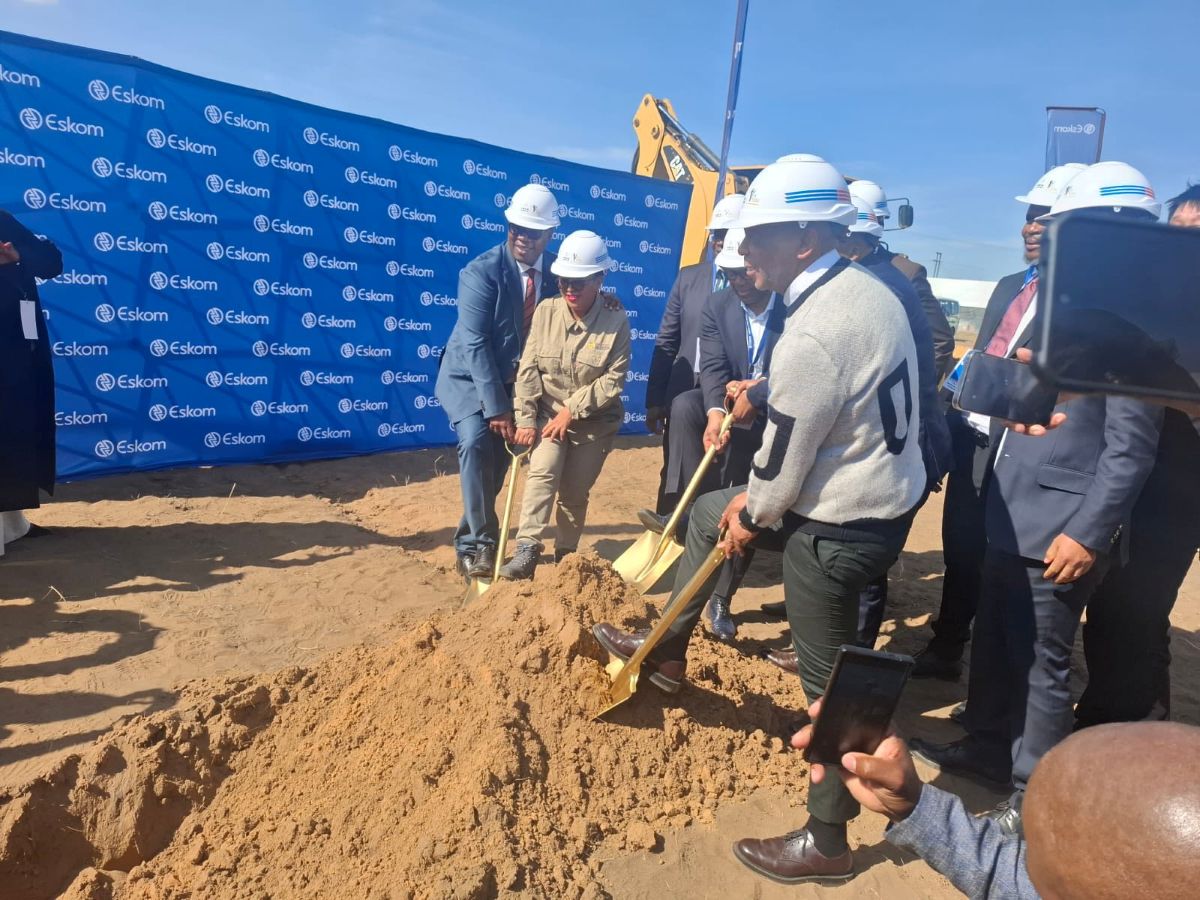
SASOLBURG — In a milestone shift for South Africa’s energy landscape, Eskom Green has officially commenced construction on a R1.2 billion, 75-megawatt (MW) solar photovoltaic (PV) power plant at the Lethabo Power Station in the Free State Province.
The project represents a critical watershed moment: the first integration of utility-scale renewable generation directly within the infrastructure footprint of Eskom’s existing coal-fired power station fleet.
Once completed, the Lethabo solar facility is projected to generate approximately 147 gigawatt-hours (GWh) of electricity annually, providing clean power to an estimated 60,000 households. Beyond greening the grid, the initiative is poised to inject vital economic opportunities and robust skills development into the local economy during both its construction and operational phases.
A Stable Foundation for Clean Energy
The sod-turning ceremony on Wednesday drew a high-profile delegation, signaling the immense political and economic weight carried by the project. Attendees included Minister of Electricity and Energy, Dr Kgosientsho Ramokgopa; Free State Premier, MaQueen Letsoha–Mathae; Gauteng Premier, Panyaza Lesufi; and top Eskom executives led by Board Chairman Mteto Nyati and Group Chief Executive Dan Marokane.
The ground-breaking comes on the heels of a major operational milestone for the utility.
“Last week we celebrated 365 days without loadshedding, as a result of the focused delivery over the past three years of the generation recovery plan by our skilled employees,” Marokane stated. “Now that we have delivered a stable electricity platform for the South African economy to grow from, we can seamlessly enable the integration of renewable energy sources as required by the 2025 Integrated Resource Plan (IRP) to maintain future energy security.”
Marokane emphasized that the utility is capitalizing on the deep technical and institutional expertise of its workforce—built over decades of public investment—to accelerate the delivery of cleaner energy.
Optimizing Coal Assets and Grid Resilience
Rather than abandoning traditional assets, Eskom’s strategy centers on co-locating new technologies to optimize existing resources.
| Key Project Metrics: Lethabo Solar PV | |
| Capital Investment | R1.2 billion |
| Generation Capacity | 75MW |
| Annual Estimated Output | 147GWh |
| Household Power Impact | ~60,000 homes |
| Financing Structure | On-balance sheet / National Treasury debt relief |
Bheki Nxumalo, Eskom’s Group Executive for Generation, noted that while coal-fired operations remain central to maintaining national grid stability, the utility is strengthening that baseload by integrating renewables on the exact same footprint.
“By leveraging established transmission infrastructure, grid connections and deep operational expertise, we can deploy new generation at pace and at scale, without compromising system reliability,” Nxumalo explained. “This is how we build forward.”
Rivoningo Mnisi, Group Executive for Renewables, added that the project provides a practical blueprint for the utility’s Just Energy Transition (JET) goals, proving that lower-carbon technology can coexist with traditional utility assets to fortify security of supply.
“Vision 2050 in Action”
For the Free State Province, the project is viewed as a cornerstone of its long-term economic trajectory. Free State Premier MaQueen Letsoha-Mathae hailed the initiative as a concrete manifestation of the reviewed Free State Growth and Development Strategy (FSGDS) Vision 2050.
“The Lethabo Solar PV Project is more than an infrastructure development; it is a strategic intervention,” Letsoha-Mathae stated, highlighting its role in driving industrialisation, job creation, and environmental sustainability.
The Premier further framed the Lethabo plant as part of a broader provincial green energy push, which includes the Matjhabeng Renewable Energy Hub and the solar-dense Xhariep region. She called for heightened inter-provincial collaboration with neighbouring Gauteng via the District Development Model to foster clean energy innovation and inclusive industrial growth.
Underscoring the focus on future generations, the ceremony featured a performance by the learners of the Thuto Lore Engineering School of Specialisation choir, symbolizing the youth’s active stake in the country’s green transition.
Scaled Ambition: The 2030 and 2040 Pipelines
The 75MW Lethabo project is merely the vanguard of a massive, multi-phase renewable energy pipeline being rolled out by Eskom.
The Short-Term Footprint (Through 2030)
Lethabo is one of 17 high-priority projects scheduled to commence construction between now and 2028 across Eskom’s existing coal-fired footprint. Collectively, these projects aim to inject approximately 6 gigawatts (GW) of new capacity into the grid by 2030. Developments will be strategically spread across major power stations, including:
- Arnot, Duvha, Majuba, and Tutuka
- Lethabo and Komati
- Kendal, Kusile, Hendrina, Camden, and Grootvlei
By utilizing existing brownfield sites, Eskom minimizes capital costs, sidesteps prolonged grid-allocation delays, and strengthens localized grid resilience.
Capital Expenditure and Funding Framework
For 2026, Eskom boasts a construction-ready pipeline of at least 2GW of renewable energy and pumped storage projects. Crucially, funding for this immediate tier has already been provisioned within Eskom’s approved capital expenditure program. It will be financed via on-balance sheet funding in strict compliance with National Treasury debt relief conditions, requiring zero reliance on additional project finance borrowing.
Looking Beyond the Coalfields
Eskom Green’s long-term commercial strategy extends far beyond its current real estate. To optimize its generation portfolio and diversify revenues, the entity plans to aggressively pursue public-private partnerships (PPPs), co-development ventures, and strategic acquisitions of advanced-stage projects in high-resource regions boasting superior wind and solar irradiation.
The utility’s ultimate blueprint involves balancing an array of technologies—including solar PV, wind, battery energy storage systems (BESS), pumped storage, and green hydrogen—to precisely align with customer load profiles.
To facilitate this massive scale-up without overburdening public finances, Eskom Green will utilize a ring-fenced funding framework. This model ensures limited recourse to Eskom’s core balance sheet by applying strict project finance principles through dedicated Special Purpose Vehicles (SPVs).
The endgame is ambitious: the advancement of a cost-competitive pipeline exceeding 32GW of renewable energy and storage projects by 2040. This long-term strategy is designed to radically diversify South Africa’s energy mix, fulfill national emission reduction targets, and crucially, enable corporate and industrial customers to successfully decarbonize their operations over the coming decades.