
 By
By 
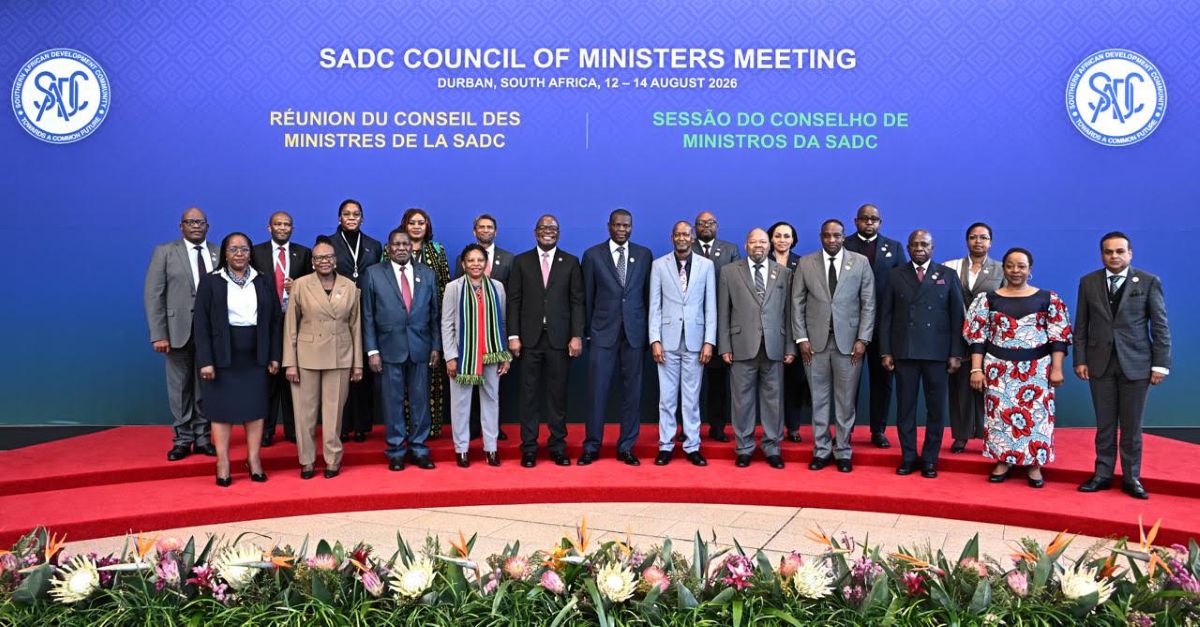
DURBAN, South Africa — The Republic of South Africa officially assumed the Chairship of the Southern African Development Community (SADC) Council of Ministers on 12 August 2026 in Durban.
Stepping into the role through August 2027 following its tenure as Interim Chair since November 2025, Pretoria takes the regional steering wheel at a pivotal juncture, demanding a sharper focus on economic sovereignty, mineral processing, and regional stability.
The handover took place on the eve of the 46th Summit of SADC Heads of State and Government. Serving as the central administrative and policy advisory organ overseeing the implementation of SADC strategy, the Council set an ambitious tone for the upcoming summit.
Moving Beyond Raw Exports: A Focus on Industrialisation
South Africa’s Minister of International Relations and Cooperation, Ronald Lamola, formally accepted the Chairship with a robust call to action, setting out a vision anchored in peace, structural economic transformation, modernised infrastructure, and human capital growth.
At the heart of Pretoria’s vision for the next year is a commitment to accelerate industrialisation across Southern Africa. Minister Lamola emphasised that the region must break free from historical extraction models that have long seen raw critical minerals—such as cobalt and graphite—shipped overseas without benefiting local economies.
“Southern Africa possesses significant reserves of critical minerals,” Lamola noted, arguing that the region must move beyond exporting raw commodities to focus on local beneficiation, processing, and manufacturing. By creating value locally, developing agricultural value chains, and driving intra-SADC trade, the bloc aims to establish a self-sustaining regional economy.
To support this industrial push, Lamola highlighted the urgent need to expand and modernise shared infrastructure. Upgrades across energy systems, transport corridors, port facilities, digital networks, and water infrastructure were presented as foundational prerequisites for cross-border trade, job creation, and industrial scale.
Youth Demographics and Mobility
Addressing the region’s acute demographic realities, Lamola stressed that nearly 60% of Africa’s population is under the age of 25. Harnessing this demographic dividend will require SADC nations to aggressively invest in targeted education, practical skills development, and sustainable youth employment opportunities.
The Chairperson also raised the delicate issue of regional mobility. Pushing for a balanced approach to migration, he urged Member States to address irregular migration through structured, lawful channels while championing the adoption of the SADC Protocol on the Free Movement of People to accelerate true regional integration.
Lamola extended congratulations to the Republic of Zimbabwe on its election as a Non-Permanent Member of the United Nations Security Council for 2027–2028, framing the seat as an essential platform to champion Southern African and broader continental priorities on the global stage.
A Pitch for Financial Sovereignty and Security
Echoing the call for deep-seated regional self-reliance, Zimbabwe’s Minister of Foreign Affairs and International Trade, Professor Amon Murwira, urged the Council to move decisively from reliance on external actors toward sustainable financial independence.
Minister Murwira laid out a strategy resting on four interconnected pillars: peace and security, industrialisation, infrastructure modernization, and human capital development. He reinforced the need for Southern Africa to transform into a competitive global production hub through investments in science, technology, and mineral beneficiation.
Crucially, Murwira urged Member States to fund regional priorities through the SADC Regional Development Fund (RDF). Strengthening the RDF, he argued, is vital to securing the bloc’s sovereign decision-making and ending financial dependence on foreign aid donors. Reaffirming the principle of collective security, Murwira added that regional peace operations must be sustainably financed from within the region to ensure long-term stability.
Regional Gains Amid Global Turbulence
SADC Executive Secretary Elias M. Magosi delivered a measured operational overview, praising the region’s resilience despite volatile geopolitical shifts and a global decline in international development assistance.
Magosi pointed to tangible structural progress across SADC, revealing that installed electricity generation capacity has now exceeded 88,000 megawatts. Regional electricity access expanded from 56% in 2024 to 60% in 2025, though he reminded ministers that concerted effort is required to hit the ambitious 85% target by 2030.
On the economic front, Foreign Direct Investment (FDI) into the SADC region jumped by 44% to reach $11 billion, primarily driven by substantial capital inflows into Mozambique and South Africa. Intra-regional trade also recorded notable growth, proving the resilience of regional commerce despite broader global trading headwinds.
The Executive Secretary highlighted ongoing stabilization efforts and security progress in the Democratic Republic of Congo and Madagascar, reinforcing that governance and security remain preconditions for regional growth.

Climate Risks on the Horizon
Despite economic gains, climate change continues to pose an existential threat to regional stability. Magosi warned that forecasts indicate a potential severe El Niño event in the upcoming season. He called for immediate, aggressive investments in climate-smart agriculture, early warning systems, disaster risk management, and climate-resilient infrastructure to safeguard food security and protect vulnerable youth, who account for nearly 75% of the SADC population.
As South Africa takes up the ministerial gavel for the year ahead, the agenda set in Durban makes one priority clear: Southern Africa’s path to long-term prosperity depends on transforming raw wealth into industrial strength, building local capacity, and securing its own peace.