
 By
By 
With the cost of living getting more expensive by the day due to increasing fuel prices attributed to the continued tensions in the Middle East, an increase in unemployment is just one of the signs that the economy is not growing as fast as it should.
Though there are some green shoots in the country’s domestic economy, South Africa is struggling to reduce its high unemployment rate. The announcement by Stats SA on Tuesday, 12 May 2026, in its Quarterly Labour Force Survey (QLFS) report for quarter one was rather disheartening and troubling.
According to the report, there was a decrease of 345 000 in the number of employed persons to 16,8 million, while there was an increase of 301 000 in the number of unemployed persons to 8,1 million compared with Q4: 2025 results. This resulted in a decrease of 44 000 (or -0,2%) in the labour force during the same period.
Stats SA says the changes in employment and unemployment resulted in the official unemployment rate (LU1) increasing by 1,3 percentage points from 31,4% in the fourth quarter of 2025 to 32,7% in the first quarter of 2026.
In the same period, discouraged job-seekers increased by 178 000 to 3,9 million, other available job-seekers increased by 55 000 to 910 000, and unavailable job-seekers increased by 6 000 to 49 000, resulting in a total net increase of 240 000 to 4,9 million in the potential labour force population (i.e. persons who were available but not seeking or unavailable but seeking). Those outside the labour force for other reasons decreased by 75 000 to 12,4 million. Persons outside the labour force, which is the total of those in potential labour force and others outside the labour force, increased by 164 000 to 17,3 million in the first quarter of 2026.
In addition to the unemployment rate (LU1), other measures of labour underutilisation (LU) were measured. The combined rate of unemployment and time-related underemployment (LU2) increased by 1,6 percentage points to 35,9%; the combined rate of unemployment and potential labour force (LU3) increased by 1,6 percentage points to 43,7% in the first quarter compared with the fourth quarter of 2026.
The composite measure of labour underutilisation (LU4) (which combines time-related underemployment, unemployment and potential labour force as a proportion of extended labour force) was 46,3% in the first quarter of 2026. These labour underutilisation measures highlight people in different situations and with different degrees of attachment to the labour market.
The number of persons employed in the formal sector decreased by 189 000 in Q1: 2026, and informal sector employment also decreased by 127 000 over the same period.
Increases in industry employment were recorded in Manufacturing (38 000), Mining (32 000) and Agriculture (10 000). The largest decreases in employment were recorded in Community and social service (206 000), Construction (110 000) and Transport (30 000).
KwaZulu-Natal (6 000) is the only province that observed an increase in employment. The largest employment decreases were recorded in North West (80 000), Gauteng (67 000), Mpumalanga (54 000), Eastern Cape (43 000) and Limpopo (43 000) during the same period.
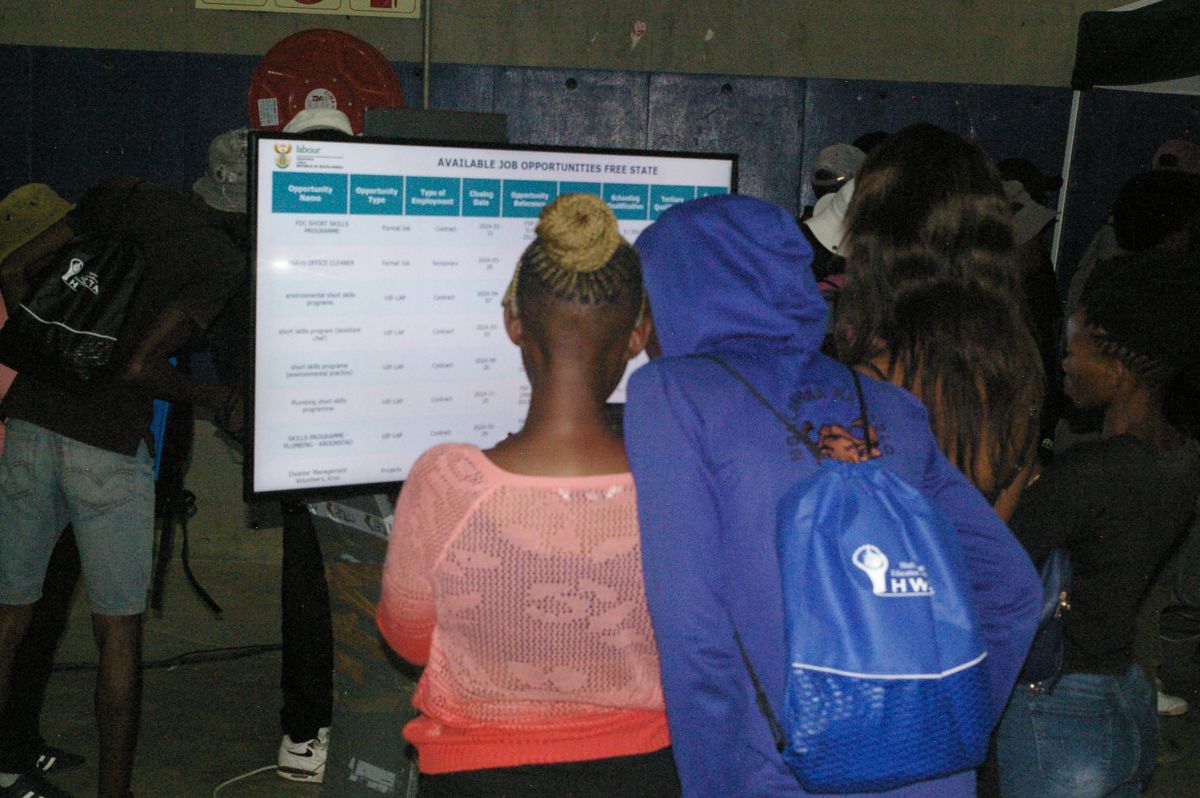
Results for the first quarter of 2026 show that the total number of unemployed youth (15-34 years) increased by 181 000 to 4,7 million compared with quarter four of 2025, while employed youth recorded a decrease of 258 000 to 5,6 million. As a result, the youth unemployment rate increased by 2,0 percentage points to 45,8% in the first quarter of 2026.