 By
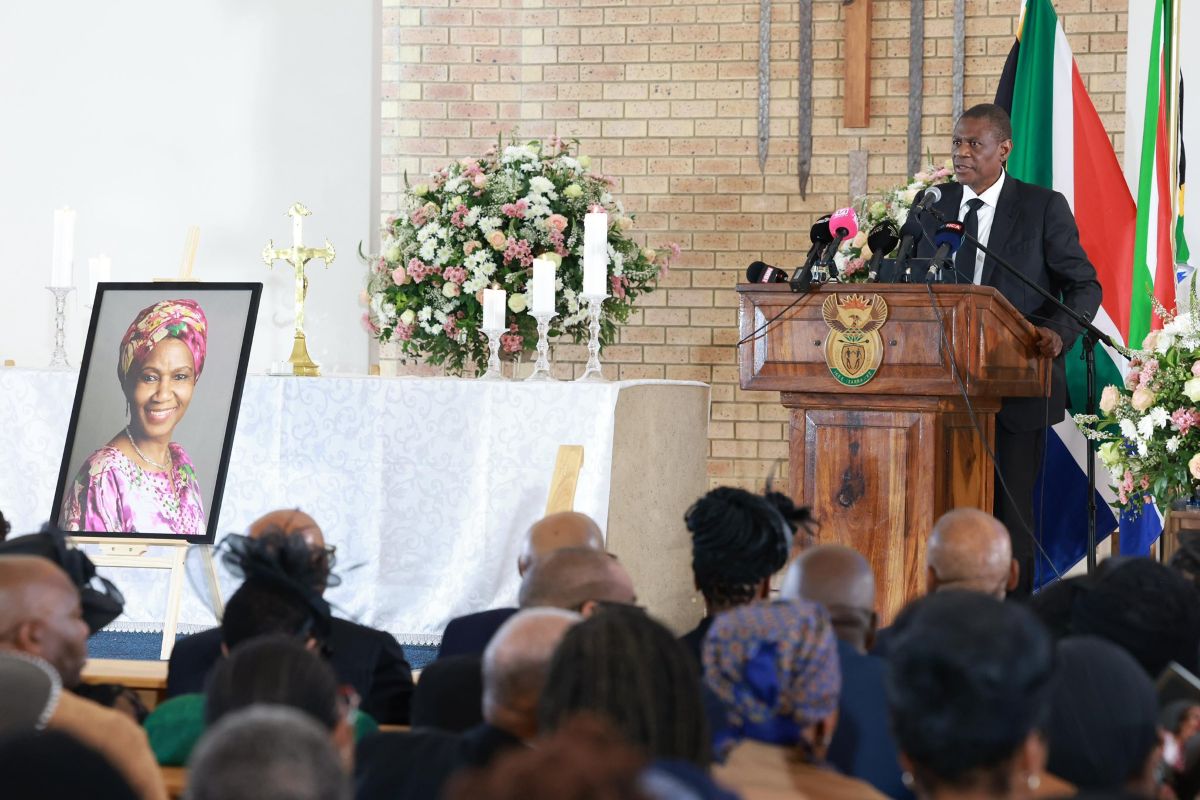
JOHANNESBURG — Deputy President Paul Mashatile has used his memorial tribute to former Deputy President Dr Phumzile Mlambo-Ngcuka to urge South Africans to dismantle the remaining barriers to women’s leadership, calling for a woman to ascend to the country’s highest political office.
Addressing mourners at Our Lady of Lourdes Catholic Church in Rivonia on Tuesday, Mashatile framed Mlambo-Ngcuka’s passing as the closing of a defining chapter in South Africa’s democratic transition.
Speaking on behalf of President Cyril Ramaphosa and the government before an audience that included former President Thabo Mbeki, former Deputy President Baleka Mbete, cabinet ministers, diplomats, and members of the Mlambo and Ngcuka families, Mashatile argued that the late stateswoman’s legacy demands action rather than mere commemoration.
“We must continue advancing the cause closest to her heart: the empowerment of women and girls,” Mashatile told the gathering. “We must build a South Africa where women occupy every space of leadership and influence, including, in our lifetime, the highest office in the land.”
Mlambo-Ngcuka, who made history in 2005 as South Africa’s first female Deputy President under Mbeki’s administration, was remembered by Mashatile not simply for the offices she held, but for her insistence that political liberation remains incomplete without economic inclusion.
Tracing her trajectory from the anti-apartheid struggle to the halls of global diplomacy, Mashatile highlighted her foundational role in shaping the post-1994 state. As a member of South Africa’s first democratic Parliament and the Constituent Assembly, she contributed to drafting the 1996 Constitution.
Later, in the executive branch, she pushed structural economic reforms—first as Deputy Minister of Trade and Industry, where she focused on expanding access for small businesses and historically disadvantaged groups, and subsequently as Minister of Minerals and Energy. In the mining portfolio, she helped spearhead the Mining Charter, a policy instrument designed to open up an industry historically closed to black South Africans.
When she assumed the deputy presidency in 2005, her focus shifted toward tackling structural unemployment and skills deficits through flagship state programmes such as the Accelerated and Shared Growth Initiative for South Africa (ASGISA) and the Joint Initiative on Priority Skills Acquisition (JIPSA). According to Mashatile, her stewardship of JIPSA ensured that women and youth remained central to the state’s developmental agenda.
Beyond domestic politics, Mlambo-Ngcuka’s tenure as United Nations Under-Secretary-General and Executive Director of UN Women cemented her reputation as a leading global advocate for gender parity. Mashatile pointed to her launch of the global HeForShe campaign and her vocal push for women to occupy the highest echelons of international governance, recalling her argument that institutional attitudes—rather than a lack of qualified women—remained the primary obstacle to equality.
Referencing recent remarks by Mbeki to the SABC, Mashatile noted that her appointment to UN Women reflected the deep international respect she commanded across Africa and the broader global community.
Even after stepping back from formal executive office, Mlambo-Ngcuka remained active in education and continental conflict resolution. She served as Chancellor of the University of Johannesburg while completing her own doctoral studies, reinforcing her view of education as a primary driver of social mobility.
On the diplomatic front, she played a key mediating role in the 2022 peace talks between the Ethiopian government and the Tigray People’s Liberation Front. Mashatile also revealed that he had recently consulted her, in his capacity as Special Envoy to South Sudan, regarding strategies to support peace-building and credible elections in the country—an invitation she readily accepted despite her commitments.
In a pointed reflection on political ethics, Mashatile noted that Mlambo-Ngcuka’s career demonstrated “integrity, courage, and a commitment to the greater good, especially during politically uncertain times”—a period widely associated with the turbulent political shifts of the late 2000s.
Concluding his address with traditional farewells in isiZulu and Sesotho, Mashatile extended the state’s condolences to her husband, former National Director of Public Prosecutions Bulelani Ngcuka, their children, and the broader family, stating that while her earthly journey had ended, her mission to build a non-racial, non-sexist society remains unfinished business for the nation.