
 By
By Gauteng’s economic engine relies heavily on the efficiency and reliability of its transport network. Tabling the Gauteng Department of Roads and Transport’s 2025/26 Annual Report before the Provincial Legislature on Friday, 4 September 2026, MEC Kedibone Diale-Tlabela presented a detailed account of capital deployment, job absorption, and modernized public service access.

However, beneath the structural progress lies a persistent battle against financial tightness, contractor underperformance, and widespread asset vandalism that threatens the province’s economic momentum.
Capital Delivery and Network Preservation
Over the past five years, state intervention across the provincial road network has focused primarily on asset preservation and critical corridor expansion. The Department executed more than 52,000 pothole repairs, resurfaced approximately 650,000 square metres of road, and completed 40,483 square metres of edge repairs to slow systemic road degradation and preserve key logistics routes.
On capital infrastructure, 13 major projects reached completion[cite: 1]. Strategic arterial routes—including upgrades to the R101, K46, K69, and K73/D51—were finalized alongside 97 kilometres of upgraded roads delivered under the targeted Emfuleni 40 Roads Programme.
Key structural rehabilitation projects were completed on Road D483 and Road P241, while major bridge infrastructure, including the Hendrik Potgieter Bridge and the K174 Vaal River City Interchange, underwent structural reinforcement. These projects directly target lowering transport overheads, easing congestion between economic hubs, and improving freight efficiency across the province.
Key Investment & Delivery Indicators (5-Year / 2025–26 Overview)
- Road Maintenance: Over 52,000 pothole repairs and 650,000 m² of road surface maintained.
- Capital Delivery: 13 major infrastructure projects completed; 97 km delivered under the Emfuleni 40 Roads Programme.
- Job Creation: 7,064 EPWP work opportunities created (4,005 youth, 4,335 women, 43 persons with disabilities).
- Traffic Signals: 130 vandalised intersections rebuilt out of 547 total responsibility; 330 operational as of May 2026.
- Service Accessibility: 3 Smart Licensing Centres established (Mamelodi, Soweto, Mohlakeng), generating 30 permanent jobs.
Employment Absorption and Labour Dynamics
In an environment defined by high youth unemployment, public infrastructure spend remains a vital mechanism for labour absorption. Through the Expanded Public Works Programme (EPWP), the Department generated up to 7,064 work opportunities.
Notably, young people secured 4,005 of these roles, women accounted for 4,335 placements, and 43 positions went to persons with disabilities. Channelling young workers into routine road maintenance strengthens skills development while providing immediate wage support in marginalized areas.
Vandalism Friction and Decentred Public Services
A persistent friction point in Gauteng’s transport economics is the recurring capital cost caused by cable theft and vandalism. Of the 547 signalised intersections under provincial oversight, 130 damaged intersections required rebuilding over the five-year period. As of May 2026, 330 intersections were fully operational, illustrating the continuous financial burden required just to maintain basic traffic flow.
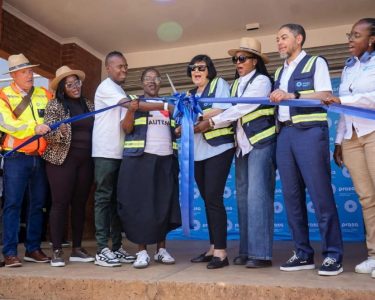
To improve public service delivery, the Department continued rolling out its #GrowingGauteng Together Through Smart Mobility 2030 Plan. Key achievements include the completion of the Vereeniging Main Taxi Rank, offering safer infrastructure for southern commuters, and three Smart Licensing Centres in Mamelodi, Soweto, and Mohlakeng.
These automated facilities have streamlined driver licensing while creating 30 permanent positions. Furthermore, a 300-vehicle pilot of the new Vehicle Number Plate System was concluded via g-Fleet Management, establishing a framework for a national rollout to assist law enforcement.
“The standard against which the Department must continue to be judged is delivery—fixing roads before deterioration becomes a greater burden, restoring vandalised traffic infrastructure, providing safe and dignified public transport facilities, bringing licensing services closer to residents, and directing infrastructure investment towards economic opportunity.” — MEC Kedibone Diale-Tlabela
Addressing Structural Constraints and Long-Term Strategy
Despite progress, the Department openly acknowledged ongoing execution risks. Delivery across several projects continues to be hindered by financial constraints, contractor delays, community disruptions, and administrative capacity bottlenecks.
To address these structural deficiencies, management committed to stricter contract oversight, improved project planning, and formal consequence management for non-performing service providers.
Looking ahead, the province is implementing its 25-year Integrated Transport Master Plan, focusing on freight logistics, transit-oriented development, universal accessibility, and decarbonisation. Institutional reforms are also progressing with the establishment of the Transport Authority of Gauteng to centralize provincial transport planning and operations. Major future capital initiatives—including the expansion of the Gautrain network and the proposed Gauteng-Limpopo high-speed rail link—will require private sector participation and rigorous financial modelling to guarantee long-term solvency.