 By
By 
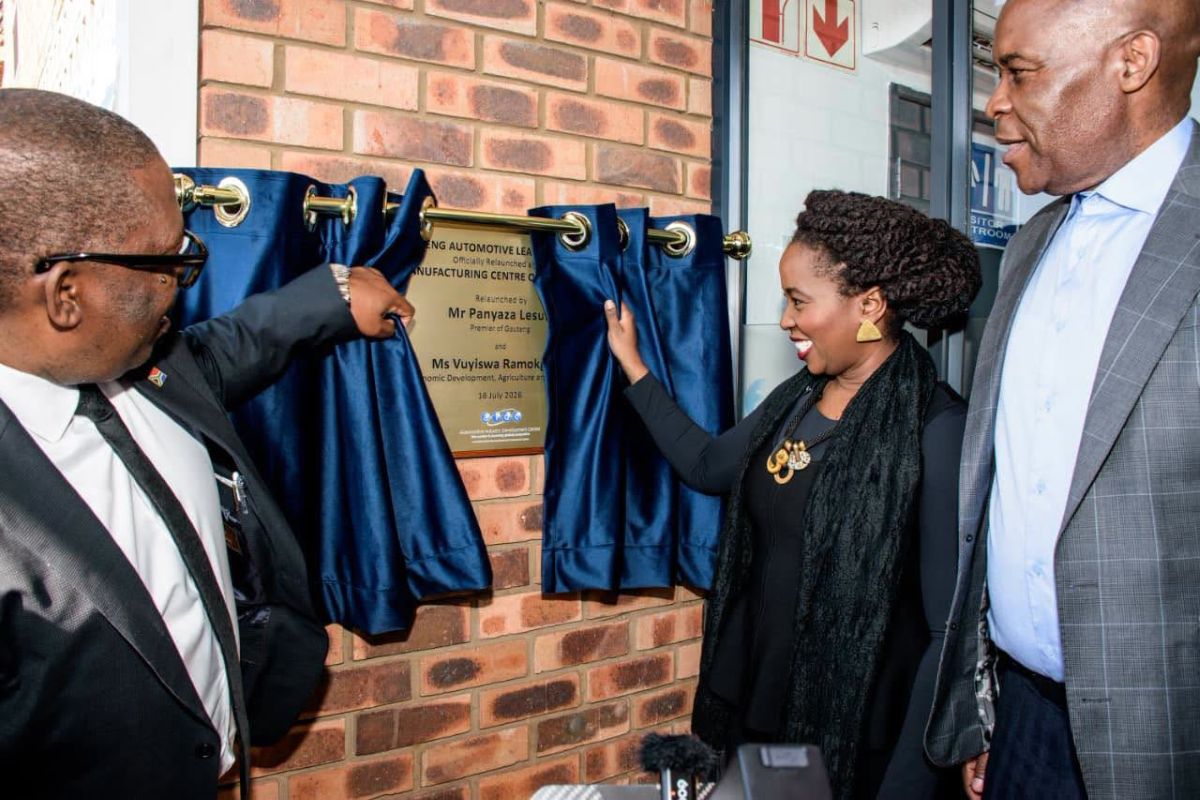
GAUTENG, SOUTH AFRICA — In the high-stakes arena of global industrial competition, a quiet but profound shift is occurring within South Africa’s economic heartland. On July 16, 2026, Gauteng’s Member of the Executive Council (MEC) for Economic Development, Ms Vuyiswa Ramokgopa, together with the Gauteng Province Premier Mr Panyaza Lesufi officially launched the new Manufacturing Centre of Excellence (MCE).
The unveiling marks a major evolution of the former Gauteng Automotive Learning Centre (GALC). In an era defined by artificial intelligence, smart factories, and electric mobility, the facility represents a strategic retooling of the province’s labour force to secure its industrial future.
The Macroeconomic Stakes of South Africa’s Auto Sector
To understand why this transition is critical, one must look at the sheer weight of the automotive industry on the national balance sheet.
- GDP Contribution: The automotive sector contributes a substantial 5.2% to South Africa’s national Gross Domestic Product.
- Manufacturing Muscle: It accounts for nearly 24% of the country’s total manufacturing output.
- Employment Engine: The sector directly employs over 113,000 people and indirectly supports approximately half a million jobs across the wider economy.
- Export Powerhouse: In 2025, South African vehicle and component exports to 154 international markets reached an estimated R291 billion.
However, as global supply chains pivot toward electric vehicles (EVs) and automated assembly lines, reliance on legacy manufacturing methods poses an existential risk. Industrial competitiveness is no longer decided purely by the lowest production costs, but by the agility of a nation’s innovation ecosystem and the adaptability of its workforce.
Beyond the Assembly Line: Skills as Economic Infrastructure
During her address, MEC Ramokgopa reframed how we view technical education, arguing that skills are economic infrastructure. Much like roads and deep-water ports, high-tech skills act as the critical conduits that connect labour to capital and domestic output to global markets.
While the original Gauteng Automotive Learning Centre served the province well—training 24,631 learners since 2013—the modern economy demands an entirely different calibre of technical literacy.
Legacy Focus (GALC) ───► Future Focus (MCE)
• Traditional Auto • Industrial Robotics & Automation
• Basic Assembly • 3D Printing & Additive Manufacturing
• Internal Combustion • EV High-Voltage Systems
• Hydraulics, Pneumatics & Root Cause Analysis
By focusing on these advanced modules, the MCE ensures that South African graduates are equipped with internationally recognized competencies. This curriculum is backed by a coalition of global and domestic partners:
- Festo: Providing exposure to cutting-edge industrial automation.
- Christiani: Delivering world-class technical training systems aligned with global standards.
- Chrisnel SA & Uyilo: Ensuring the province remains at the absolute forefront of electric vehicle mobility and high-voltage training.
- eNtsa: Driving research and advanced technology transfer.
Democratizing the Value Chain: Bridging the Township Divide
One of the most compelling economic dimensions of Gauteng’s strategy is its focus on inclusive growth. Historically, technological leaps have concentrated wealth within large, established corporations, leaving smaller enterprises behind.
The MCE is intentionally structured to break this cycle. The centre has already begun training students from the Tshwane North TVET College and the Lethabong School of Specialisation, opening up highly technical career paths for youth from communities like Mamelodi and Soshanguve.
Furthermore, the Automotive Industry Development Centre’s (AIDC) Automotive Township Hubs are actively helping local mechanics and small-business owners transition toward EV maintenance and advanced diagnostics. This prevents the displacement of informal and township economies as the automotive landscape shifts toward electric mobility.

Securing Foreign Direct Investment (FDI)
For Gauteng’s industrial corridors, particularly the automotive hub of Rosslyn, the launch of the MCE is a strong signal to global markets.
Multi-national manufacturers do not invest capital in a vacuum; they seek labour markets that can sustain highly complex operations. Recent milestone investments, such as Chery’s decision to establish manufacturing operations in Gauteng, underscore the province’s growing status as an attractive destination for advanced manufacturing.
By aggressively developing its human capital, Gauteng is de-risking future foreign direct investments. It offers global automakers a guarantee that they will find the engineers, technicians, and automated systems specialists required to run modern plants.
The Road Ahead
As Gauteng Premier Panyaza Lesufi and industry leaders look to the future, the launch of the Manufacturing Centre of Excellence serves as a blueprint for proactive industrial policy. Rather than waiting for global technological shifts to disrupt its manufacturing base, Gauteng is choosing to actively shape the transition.
In the words of MEC Ramokgopa, the emerging global economy will reward curiosity, adaptability, and continuous learning. With the MCE, Gauteng is not just building a training facility; it is securing South Africa’s position as the industrial engine of the African continent.