 By
By JOHANNESBURG — Following the conclusion of a high-stakes two-day Pollution Summit, the Gauteng Provincial Legislature’s Environment, Agriculture and Rural Development (EARD) Portfolio Committee has drawn a hard line against environmental mismanagement, demanding robust enforcement, infrastructure renewal, and strict accountability from polluters and government bodies alike.

For the committee, the core message emerging from the summit is unequivocal: environmental degradation is not merely a technical ecological problem; it is a profound human rights issue and a crisis of accountability.
Communities across South Africa’s economic heartland can no longer be expected to bear the social, health, and economic costs of failing infrastructure, unpunished industrial emissions, and chronic sewage spills.
A Crisis in Water and Wastewater Management
Aging sewer and wastewater networks, compounded by rapid population growth and the proliferation of informal settlements, have placed unprecedented stress on Gauteng’s water systems. Rivers and dams continue to suffer from inadequate sanitation management and recurring sewage overflows.
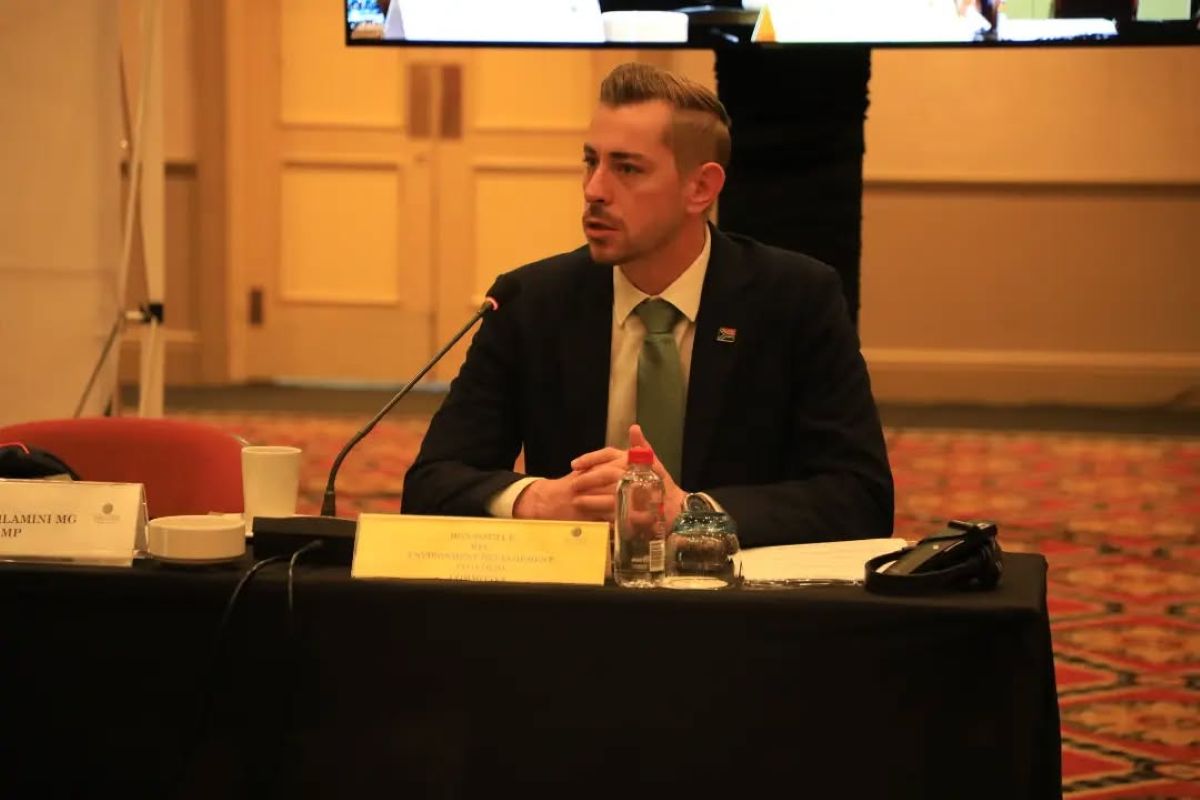
During the summit, Hon. Bones Modise, Chairperson of the Select Committee on Agriculture, Land Reform and Mineral Resources, underscored the urgent need to hold key national bodies—specifically the Department of Forestry, Fisheries and the Environment (DFFE) and the Department of Water and Sanitation (DWS)—fully accountable for reinforcing wastewater infrastructure and enforcing environmental compliance across all provinces.
The committee stressed that residents should never be left to live alongside polluted waterways simply because municipal and regional infrastructure fails to keep pace with urban development.
Industrial Emissions and the Air Quality Battle
Air pollution was another critical focal point during the deliberations. Experts and committee members raised deep concerns regarding unregulated industrial emissions, inadequate monitoring networks, and high concentrations of particulate matter, particularly fine particulate matter such as PM2.5.
The EARD Portfolio Committee emphasized that industries required to monitor and report regulated emissions must face stricter oversight. Effective air-quality management requires more than theoretical plans; it demands aggressive implementation, transparent public reporting, and rigorous protection for vulnerable communities living adjacent to industrial hubs.
Moving Beyond Talk to Enforceable Action
Addressing delegates, EARD Portfolio Committee Chairperson Hon. Jaco Mulder highlighted the human toll of ecological neglect.
“Pollution affects real people—their homes, their health, their livelihoods, and the communities in which they live,” Mulder stated. “The Pollution Summit has reinforced the need for Gauteng to move from discussion to measurable and enforceable action.
Our responsibility as a Legislature is to strengthen oversight, hold responsible departments, municipalities, and polluters accountable, and ensure that pollution is addressed at its source.”
To ensure the summit does not devolve into a mere talk shop, the EARD Portfolio Committee has vowed to integrate the event’s outcomes directly into its ongoing legislative oversight programme. This will involve active tracking of commitments, interrogating implementation timelines, and demanding immediate corrective action where environmental obligations are neglected.
Strengthening the Arm of the Law
In a bid to close the enforcement gap, the committee is championing closer coordination with the Justice, Crime Prevention and Security (JCPS) Cluster at the provincial level. By fostering tighter cooperation between Environmental Management Inspectors, law-enforcement agencies, and prosecutorial authorities, the province hopes to leverage environmental intelligence to ensure that ecological offenses result in severe penalties and mandatory environmental rehabilitation.
Ultimately, the EARD Portfolio Committee maintains that the summit marks the beginning—not the end—of an intensive oversight campaign. As Gauteng looks toward cleaner water, breathable air, and safer communities, the legislature’s message to polluters and negligent institutions is clear: the era of impunity is over.