 By
By 
The growing pace of South Africa’s economy is not complemented by the debt to GDP ratio, though there are some improvements in the economy, with the Rand strengthening against the US Dollar; the country’s borrowing remains a serious concern.
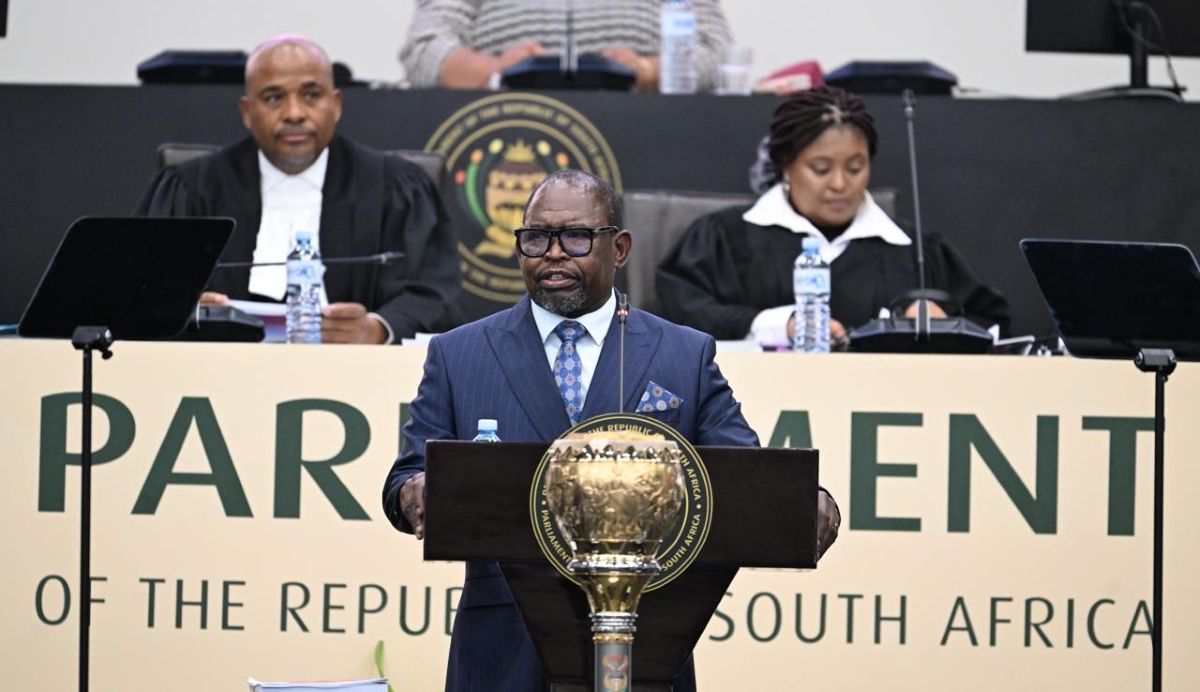
The Minister for National Treasury Mr Enoch Godongwana delivered his budget speech on Wednesday, 25 February 2026, which fortunately was not opposed or interrupted as compared to last year’s one reflecting the teething problems of the Government of National Unity (GNU).
Godongwana presented the outlook of the domestic economy; he said the economic growth for 2026 is projected at 1.6%, an improvement from 1.4% estimated in 2025. He said this improvement reflects the continued strengthening of economic performance from the second half of 2025. The continued improvement can also be witnessed in the strengthening of the Rand against the US Dollar, with markets closing with the Rand soaring at R15.89 on Wednesday.
The Minister said over the medium term, growth is expected to average 1.8%, reaching 2% by 2028.
“Persistent logistics bottlenecks, weak public infrastructure and the recent outbreak of foot and-mouth disease continue to weigh on economic activity and pose risks to the outlook,” said Godongwana.
Though encouraging that the economy is growing, the pace of growth compared to the country’s debt to GDP is disheartening, the economy is still choked by debt, South Africa pays way too much towards debt. For every Rand, the country pays about 79 cents towards debt.
The Minister said debt is stabilising and has been reduced by more than 4% for the financial year 2025/26.
“The consolidated budget deficit has narrowed to 4.5 per cent of GDP for 2025/26, an improvement from 4.8 per cent that we estimated in the 2025 Budget. The deficit falls to 4 per cent in 2026/27 and 3.1 per cent the year after.
Gross debt stabilises as a share of GDP in 2025/26, at 78.9 per cent. In 2026/27 it falls further, to 77.3 per cent of GDP and declines to 76.5 per cent by 2028/29. The slightly higher debt peak this year reflects weaker nominal GDP growth and our decision to take advantage of strong investor demand in domestic and global markets by increasing issuance in 2025/26,” said Godongwana.
“The main budget primary surplus for 2025/26 reaches 0.9 per cent of GDP. In the next financial year it expands to 1.6 per cent, and then to 1.9 per cent in 2027/28. By 2028/29, we see it reaching 2.3 per cent.
To sustain fiscal discipline, we intend to continue the engagements on fiscal anchors. We aim to introduce a proposal for a principle-based fiscal anchor in the Medium-Term Budget Policy Statement after thorough consultation in Cabinet, Parliament and with the public. Just as inflation targeting provided clarity and credibility to monetary policy, the fiscal anchor aims to entrench fiscal credibility,” he continued.