 By
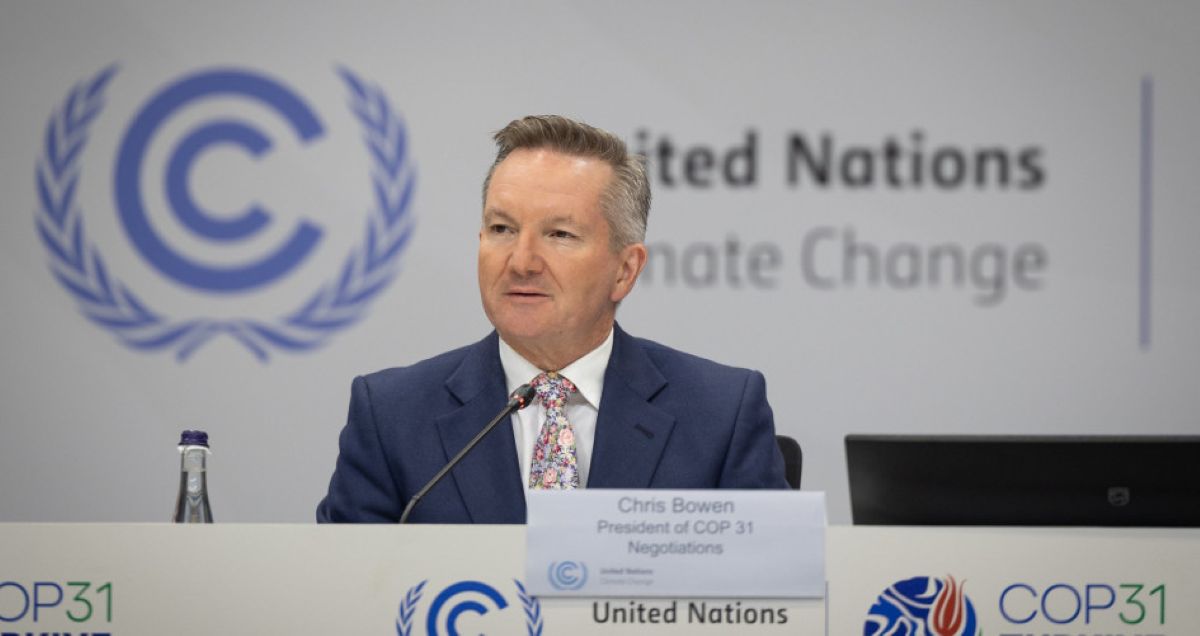
ANTALYA, Türkiye — Setting a rapid and transparent pace for global climate diplomacy, COP31 President of Negotiations Minister Chris Bowen unveiled the first draft of the presidency-led decision—widely known as the cover decision—during a high-stakes press conference in Antalya, Türkiye.
Released just half an hour prior to the briefing, the comprehensive draft marks an aggressive departure from traditional UN climate summits, where overarching political decisions are frequently withheld until the eleventh hour.
Addressing journalists from around the globe on 16 November 2026, Minister Bowen emphasized that releasing the document early in the process was a deliberate strategy to anchor upcoming negotiations and ensure that the final outcome is genuinely party-owned.
“We looked at how previous presidencies have handled this issue. In some cases, the existence of a presidency-led decision was only announced during a COP. In some cases, the draft was issued very, very late… That’s not the approach we’ve taken,” Bowen stated. “This is a draft, a first draft. It won’t be the final draft. It is very much enabled to enable consideration over the next week.”
Navigating a Global Poly-Crisis
The release of the draft comes against the backdrop of what Bowen described as a worldwide “poly-crisis”—a complex convergence of escalating cost-of-living pressures, the global energy crunch, surging energy demands driven by artificial intelligence and expanding data centres, and ongoing geopolitical conflicts.
Amid these compounding global stresses, the COP31 Presidency is positioning multilateral climate action not as a competing priority, but as an essential engine for economic relief and long-term security.
“People around the world in every community are feeling the pain of that cost of living crisis and watching the unique and challenging international circumstances, and asking; ‘Can multilateralism work? What is the answer?’” Bowen noted. “Well, to no small degree, the challenge for us this week is to show that multilateralism is still important, and that international cooperation is more important in the face of the poly-crisis than before.”
To compile the text, the Presidency processed extensive input from the global community, reviewing 45 submissions spanning over 500 pages on behalf of more than 160 countries.
Key Pillars of the Draft Text
While acknowledging that the draft contains divisive elements that will require rigorous debate, Bowen highlighted several core focus areas embedded within the 144-paragraph document:
- Reaffirming the Paris Agreement: Re-centering global commitments on multilateral cooperation and keeping global warming below the critical $1.5^\circ\text{C}$ threshold as early as possible, while directly addressing temperature overshoot.
- Electrification and Energy Targets: Incorporating pathways for clean electrification, including a proposed $35\%$ target by $2035$, tailored to national circumstances and driven by domestic frameworks. Bowen welcomed recent momentum, noting that the European Union and the United Kingdom have backed the electrification pledge alongside early signatories like Australia.
- Oceans and Vulnerable Ecosystems: Highlighting the vital regulatory role of oceans within the climate system—a crucial priority for Small Island Developing States (SIDS)—alongside targeted protections for mountain and glacier-dependent communities.
- Adaptation Finance and Science: Outlining a pathway to operationalize the tripling of adaptation finance by 2035, building on the architecture established in Belém, alongside robust protections for science and information integrity.
Managing Divisive Positions and ‘Red Lines’
Unsurprisingly, the inclusion of robust policy levers has sparked immediate friction among negotiating blocs. Questioned by reporters regarding extreme positions—such as proposals calling for developed nations to achieve net-zero emissions within a compressed three-year window, or fierce debates surrounding fossil fuel phase-out language versus the transition-away framework agreed upon in Dubai—Bowen defended the inclusive nature of the draft.
“If we’re going to provide parties with an accurate reflection of what we were told, of course, some developing countries have called for that net zero date, so we accurately reflected it,” Bowen explained. “Other parties will have very strong views about that. That will be worked through in the process. So we took the view that we could not just ignore what some parties have said.”
Addressing concerns that emphasizing clean electrification might dilute commitments to transition away from fossil fuels, Bowen pushed back, framing electrification as the primary mechanism for fossil fuel replacement. “Currently the world’s energy system is about 23% electricity. The rest is by and large, fossil fuels. If you increase electricity, you’re replacing them. You’re replacing direct fossil fuel use with electricity,” he stated.
A Collaborative Co-Presidency Model
As ministers—including India’s Minister Bhupender Yadav, EU Climate Commissioner Wopke Hoekstra, and German State Secretary Jennifer Morgan—arrive in Antalya to take over the heavy lifting of political negotiations, Bowen also praised the historic co-presidency arrangement between Australia and Türkiye.
Describing the joint leadership under Turkish Minister Murat Kurum as an operational success, Bowen noted that dividing the immense logistical and diplomatic burdens of hosting a COP has allowed the teams to work with unprecedented efficiency. “Sharing the burden between Turkey and Australia has worked very well. I am full of praise for the Turkish Presidency,” he said.
With 48 technical items already resolved by negotiators and approximately 30 main mandates remaining on the table, the coming days will test the resilience of international consensus. As the Presidency prepares to issue a more concise second draft later in the week, Bowen issued a clear call to action for both boardrooms and living rooms worldwide: keep investing, keep cooperating, and keep tackling a crisis that continues to escalate.