 By
By 
SANDTON — Against a backdrop of shifting global supply chains, geopolitical realignments, and the rapid encroachment of artificial intelligence, South Africa has laid out a definitive industrial roadmap to reverse de-industrialisation and position the continent as a global manufacturing engine.
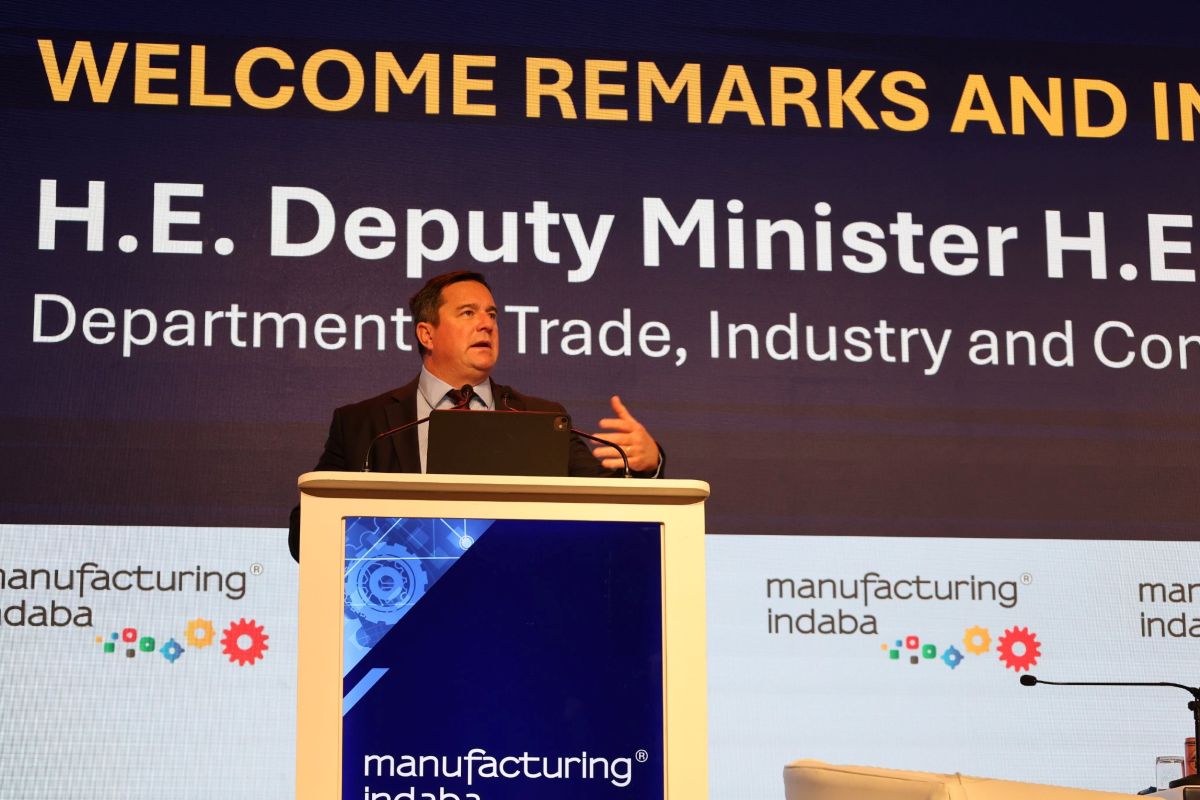
Speaking at the 2026 Manufacturing Indaba in Sandton—convened under the theme “Made in Africa for Africa”—the Deputy Minister of the Department of Trade, Industry and Competition (the dtic) Mr John Steenhuisen emphasized that supporting the manufacturing sector is no longer an optional policy choice, but an existential economic necessity.
Echoing this aggressive developmental stance, Deputy Minister John Steenhuisen has previously championed the urgency of eliminating structural bottlenecks to boost export competitiveness and ignite job creation.
The True Cost of Non-Intervention
Manufacturing currently contributes approximately 13% to South Africa’s GDP and accounts for over 1.6 million direct jobs, acting as a critical economic multiplier across mining, agriculture, and logistics. Addressing international and local business leaders, Steenhuisen countered orthodox market-led approaches, asserting that no country has successfully industrialised by leaving its productive capacity entirely to market forces.
While acknowledged as potentially costly, targeted state support—ranging from industrial financing and infrastructure investment to strict public procurement and localisation—is being framed as an investment in national economic sovereignty and long-term prosperity. South Africa simply cannot afford the alternative.
South African Manufacturing at a Glance:
┌──────────────────────────────┬──────────────────────────────┐
│ GDP Contribution │ Direct Employment │
│ ~13% │ 1.6+ Million Jobs │
└──────────────────────────────┴──────────────────────────────┘
The Three Pillars of Re-Industrialisation
To combat structural headwinds like slow growth, infrastructure backlogs, and a persistent concentration of economic power, the government’s turnaround strategy rests firmly on three core pillars:
- Diversification: Expanding the industrial base beyond traditional resource extraction into high-value sectors such as advanced machinery, chemicals, automotive components, pharmaceuticals, and electro-technical goods. Exporters in these segments will receive targeted training, market access initiatives, and specialized trade finance.
- Decarbonisation: Future-proofing the industrial base by leveraging abundant renewable energy and critical minerals to establish green manufacturing clusters, green hydrogen hubs, and advanced mineral beneficiation.
- Digitalisation: Embedding advanced automated technologies to boost productivity, scaling the Global Business Services sector, and preparing the workforce for future-proof jobs.
Crucially, the dtic emphasizes that this rebuild must be structurally inclusive, explicitly drawing in small, medium, and micro enterprises (SMMEs), youth, women, and historically excluded individuals.
Moving Up the Global Value Chain
The policy framework marks a departure from passive global integration. South Africa intends to use a robust toolkit—including regulated trade, export controls, and local content requirements—to dictate the terms of its own value chains and control the flow of its natural resources.
To make this trade drive viable, the state acknowledged that friction costs must be aggressively eliminated at critical nodes. National ports and rail networks must be rapidly upgraded to become fit for purpose, removing the inefficiencies that currently inflate the cost of doing business.
From ‘The Pit’ to ‘The Factory Floor’
The grander vision, however, extends well beyond domestic borders. The African Continental Free Trade Area (AfCFTA) and the Southern African Development Community (SADC) are highlighted as the ultimate mechanisms to transition Africa from a mere exporter of raw materials (the “pit”) into the definitive manufacturing powerhouse (the “factory floor”) for the global green economy.
The Continental Ecosystem Shift:
[ Raw Material “Pit” ] ──(AfCFTA & Regional Integration)──> [ Global Green “Factory Floor” ]
This continental industrial ecosystem will be forged through:
- Integrated Corridors: Building seamless regional trade and industrial routes.
- Complete Battery Value Chains: Developing end-to-end processing and manufacturing capabilities internally, ensuring critical minerals drive national sovereignty rather than foreign enrichment.
- Skills Mobility: Fostering the free movement of a highly skilled workforce across borders to support these emerging industries.

A Momentum-Building Month
The manufacturing agenda will shift into high gear almost immediately. In partnership with the KwaZulu-Natal province, the dtic will shortly host South Africa’s 2nd International Special Economic Zones (SEZs) Infrastructure & Investment Conference to bolster globally competitive industrial platforms.
This will be followed tightly by the 2026 Annual SADC Industrialisation Week, scheduled for 27–31 July at the Durban International Convention Centre. Serving as a high-level precursor to the 46th SADC Summit of Heads of State and Government, the event will centre heavily on leveraging critical minerals and infrastructure development to achieve a just, resilient economic transformation.
Ultimately, the blueprint presented at the Indaba underscores that the choices made today will lock in South Africa’s economic structure for decades. Transitioning this vision into reality will depend entirely on deep, sustained co-investment and execution alignment between government, labour, and private capital.