
 By
By NEW YORK — A quarter of a century after the historic World Conference against Racism convened on South African shores, Pretoria has returned to the global stage to sound the alarm on a rising tide of global intolerance, warning that the architectures of modern inequality remain deeply entrenched.

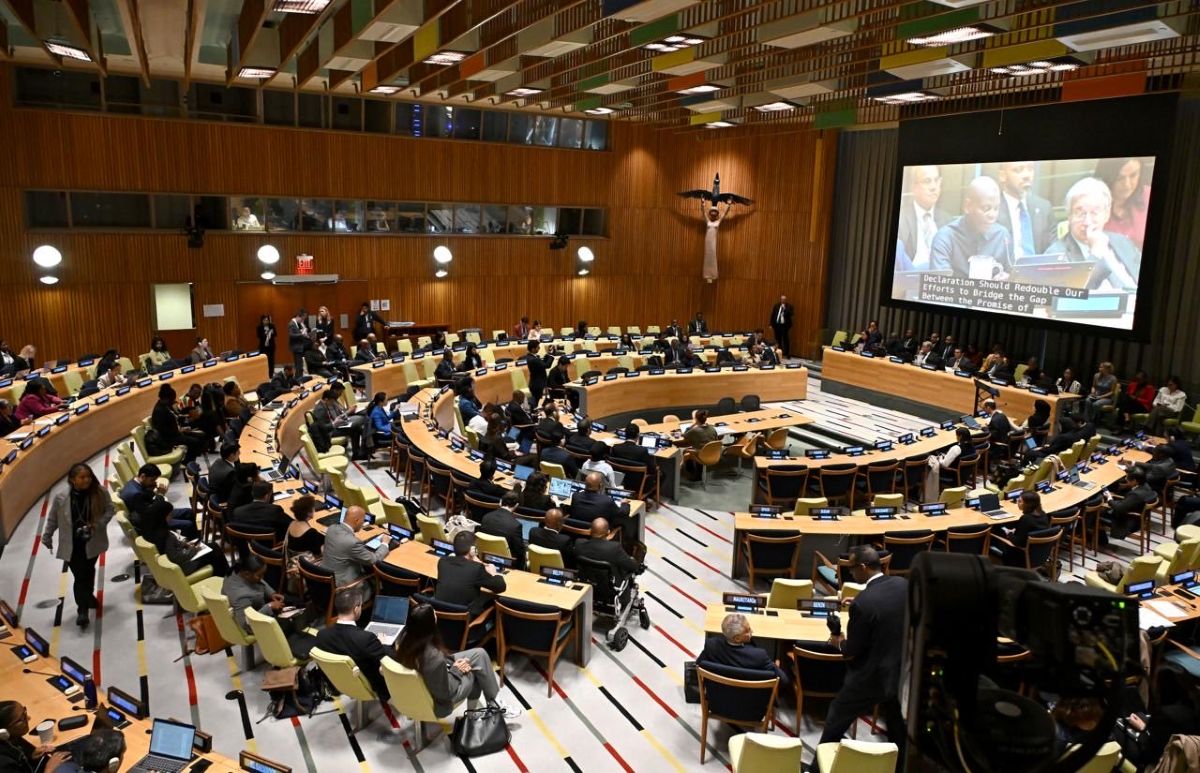
Addressing the United Nations General Assembly High-Level Meeting commemorating the 25th anniversary of the Durban Declaration and Programme of Action (DDPA), South Africa’s Minister of International Relations and Cooperation, Ronald O. Lamola, delivered a sharp critique of contemporary global politics, highlighting how online hate speech, growing anti-migrant sentiment, and a fierce backlash against anti-racism measures threaten to roll back decades of hard-fought progress.
“Twenty-five years later, the global environment is no less challenging,” Lamola told world leaders. “Racism persists. Xenophobia and related intolerance are finding renewed expression, worsened by online hate messages”.
The Echoes of 2001 and the Shadow of Modern Backlash
In 2001, the world gathered in Durban under the banner of a new internationalism championed by then-President Thabo Mbeki, seeking to repair the generational damage inflicted by slavery, colonialism, and apartheid. While that landmark conference established a vital roadmap, Lamola emphasized that legislation and state action alone have proven insufficient to eradicate prejudice.
Today, the landscape is defined by new fractures. Lamola pointed out that contemporary racism against Africans and people of African descent remains structurally embedded in the institutional systems governing human affairs. Furthermore, a global hardening of attitudes toward migrants—who are frequently weaponised and scapegoated for broader socio-economic hardships—has created fertile ground for polarization.
Without genuine international cooperation, Lamola warned, political vacuums are left wide open for actors seeking to fragment societies along racial and ethnic lines. “Failure to cooperate leaves the door wide open for actors whose conduct runs counter to the principles of equality, dignity and human solidarity,” he cautioned.
Glimmers of Hope: Reparative Justice and Cartographic Correction
Despite a fraught geopolitical climate, Lamola highlighted critical recent victories spearheaded by African nations at the UN that signal a growing appetite for historical reckoning:
- Recognition of Enslavement: Under Ghana’s leadership and with African Union backing, the General Assembly recently adopted a declaration recognizing the trafficking of enslaved Africans and racialised chattel enslavement as the gravest crime against humanity, breathing new life into demands for reparative justice.
- Correcting Global Cartography: Through Togo’s stewardship, the UN adopted a resolution to correct global cartographic representation—rebalancing maps to challenge long-standing distortions that artificially shrink the African continent.
“These advances remind us that past wrongs will not right themselves,” Lamola asserted. “Historical distortions do not correct themselves. And progress is always a product of struggle”.
A Call for Institutional Accountability
To bridge the dangerous gap between international legal promises and the everyday realities faced by citizens and marginalized groups, South Africa has urged all UN member states to establish or strengthen independent national human rights institutions. These bodies are envisioned as vital watchdogs to monitor and evaluate the implementation of Durban commitments.
Pretoria also threw its weight behind the upcoming UN Declaration on the Human Rights of People of African Descent, demanding that it serve as an actionable framework during the Second International Decade. The minister’s agenda for redress remains unequivocal: formal apologies, transparent truth-telling processes, material reparations, and the unconditional return of looted cultural artifacts to their countries of origin.
As the anniversary proceedings drew to a close, Lamola underscored that the Durban conference was never meant to be a destination, but a starting line.
“The task of building a world free of racism, righting the wrongs of the past and restoring the human dignity of all is as much ours today as it was for the generation that converged in Durban a quarter century ago,” Lamola concluded.