
 By
By South Africa’s state-owned power utility, Eskom, has announced its group annual financial results for the year ended 31 March 2026, marking a second consecutive year of profitability and underscoring a significant operational and financial recovery.

Driven by an improved operational efficiency in its generation fleet and rigorous cost discipline, the utility posted a group profit after tax of R30.3 billion, more than doubling the restated R14.0 billion reported in FY2025.
The utility’s performance was supported by an Earnings Before Interest, Taxes, Depreciation, and Amortisation (EBITDA) margin of 30.63%, up from a restated 28.75% in the previous financial year. Leadership attributed the margin expansion to reduced electricity production costs, driven primarily by lower reliance on expensive emergency open-cycle gas turbines (OCGTs) and improved plant availability.
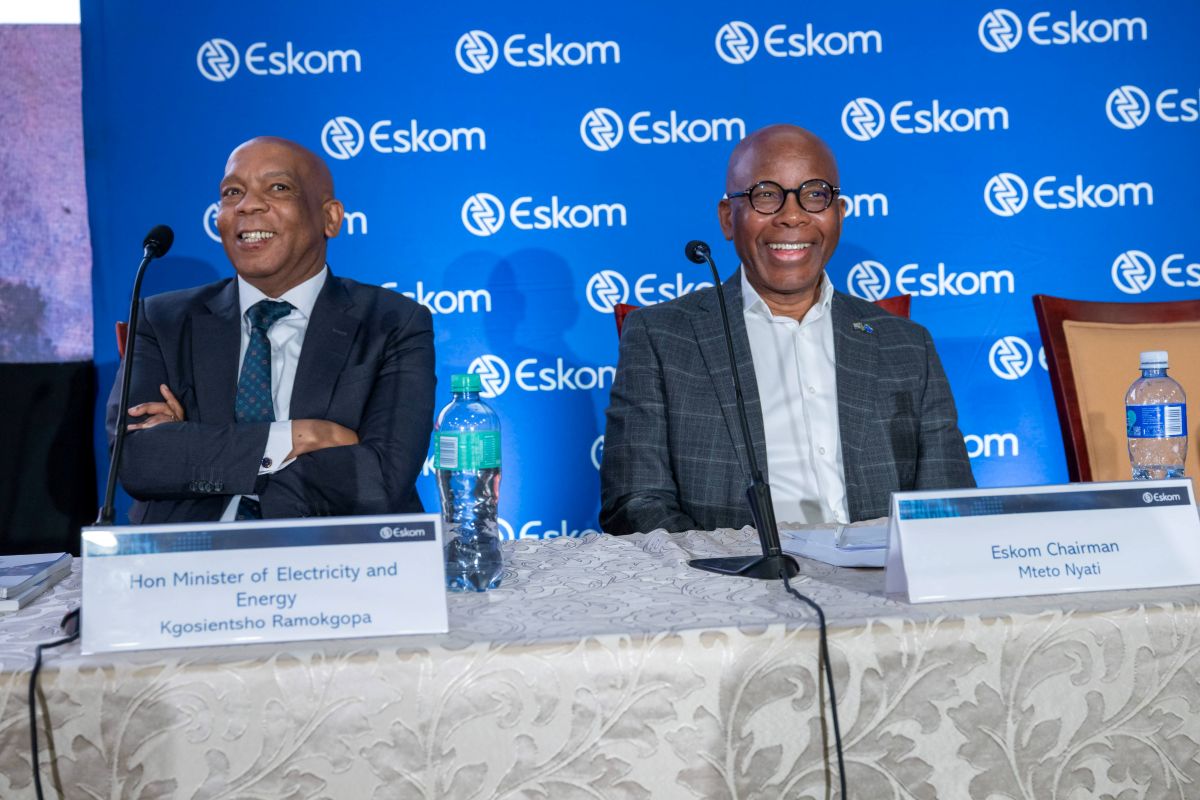
“This performance was earned through operational recovery and cost discipline,” said Eskom Chairman Mteto Nyati. “Profit is not the opposite of public purpose; it is what makes that purpose possible, allowing us to reinvest in the reliability of our fleet, grid expansion, and customer experience.”
Operational Recovery Drives Fuel Cost Savings
A core pillar of Eskom’s financial performance was the marked reduction in primary energy expenses. While reported primary energy costs increased marginally year-on-year, excluding the impact of fuel levy refunds reveals a 7% structural decline.
The improved availability of coal-fired stations, alongside the return to service of both units at the Koeberg Nuclear Power Station following scheduled maintenance, substantially lowered unit production costs. OCGT utilization was cut by more than half, resulting in a combined R10.6 billion reduction in fuel and storage expenditure across Eskom-owned units and Independent Power Producer (IPP) OCGT allocations.
This operational baseline drastically reduced systemic pressure on the broader national economy. According to Group Chief Executive Dan Marokane, load-shedding was limited to just four days totalling 26 hours in FY2026, a sharp contrast to the severe power outages that cost the South African economy an estimated R2.8 trillion in 2023.
Emerging Risk: Overcapacity and Declining Sales Volumes
Despite the strong top-line profit growth, structural shifts in South Africa’s energy landscape present new commercial challenges. Total sales volumes fell by 6.2% to 178 TWh during the financial year. The decline was most severe in the industrial sector, where demand dropped by 22.5% (9.7 TWh) due to weak economic demand, rapid adoption of private embedded self-generation, wheeling, and energy efficiency measures. Revenue grew 4.1%, largely buffered by a regulatory standard tariff increase of 12.74%.
For the first time in over a decade, generation stability combined with falling industrial demand has resulted in a structural surplus capacity of between 2 GW and 3 GW projected over the medium term.
To counter volume erosion, Eskom’s Distribution division is rolling out a targeted sales-retention and demand-activation strategy:
- Negotiated pricing agreements to protect energy-intensive customers like ferroalloy and smelter operators.
- Expansion into high-growth sectors, including data centres and electric vehicle charging infrastructure.
- Wheeling optimization, renewable power purchase agreements, and flexible load activation, including a pilot project in Bitcoin mining.
Debt Relief and Balance Sheet De-leveraging
Liquidity strengthened significantly over the period, ending at R124.9 billion in cash and cash equivalents as of 31 March 2026. The cash position was reinforced by an R80 billion final tranche of government debt relief received in March 2026, R38 billion of which was deployed in April 2026 to settle maturing ES26 bonds.
Debt securities and borrowings stood at R356 billion at the end of the fiscal year, before decreasing further to approximately R320 billion by 30 June 2026. This ongoing balance sheet de-risking spurred credit rating upgrades from S&P Global, Fitch, and Moody’s—Eskom’s first rating upgrades in over a decade.
“Government’s debt relief support has been a critical enabler, freeing up cash from operations to be reinvested in the business rather than consumed by debt servicing,” said Group Chief Financial Officer Calib Cassim.
Eskom plans to leverage its stronger balance sheet to fund a R343 billion capital expenditure program over the next five years, scaling annual CapEx from R45 billion in FY2026 to over R70 billion per year starting in FY2029.
| Key Financial Metric | FY2025 (Restated) | FY2026 | Year-on-Year Change |
| Group Profit After Tax | R14.0 billion | R30.3 billion | +116.4% |
| EBITDA Margin | 28.75% | 30.63% | +1.88% pts |
| Sales Volumes | 189.8 TWh (approx.) | 178.0 TWh | -6.2% |
| CORE Programme Savings | — | R22.4 billion | Exceeded Target |
| Debt Securities & Borrowings | — | R356.0 billion | Reduced to ~R320bn (June 2026) |
| Arrears Municipal Debt | R94.6 billion (approx.) | R111.6 billion | +17.9% |
Municipal Arrears Pose Systemic Risk
Despite positive operational metrics, municipal debt remains the largest single threat to Eskom’s long-term financial viability. Overdue municipal accounts grew 17.9% year-on-year to reach R111.6 billion at year-end, expanding further to R119 billion by June 2026. Internal projections indicate municipal debt could escalate to R358 billion by FY2031 if systemic structural interventions are not enforced.
Furthermore, an unrecognised revenue provision of R15.8 billion (roughly 4.5% of total revenue) was recorded due to high non-collectability risks across municipal, metro, and residential segments.
Governance, Audit Progress, and Executive Transition
Independent auditors Deloitte & Touche issued a qualified audit opinion for FY2026 strictly concerning the completeness of irregular expenditure reporting under the Public Finance Management Act (PFMA). However, in a major governance milestone, prior qualifications regarding the accuracy of irregular expenditure and losses due to criminal activity were officially lifted. Auditors confirmed that the financial statements were otherwise fairly presented in accordance with IFRS standards.
Financial statement restatements for FY2025 totalled R2.006 billion downward, accounting for R980 million in National Revenue Fund guarantee fees and R1.026 million in public liability claims.
Eskom also reported internal gains on crime deterrence and supply chain integrity:
- Physical security incidents fell by 13%, with losses reduced by 18% to R191 million.
- Arrests related to infrastructure crime rose 18% to 505.
- The utility officially established the Raptor Fusion Centre at its Megawatt Park headquarters to combat organized crime, sabotage, and coal supply chain fraud.
- New irregular expenditure incurred during the year dropped dramatically; out of R4.9 billion recorded, only R28 million was tied to new incidents, with the remainder stemming from legacy multi-year contracts.
The board confirmed that Group CFO Calib Cassim will retire in FY2027 after 24 years at Eskom. The succession process is underway, with the board targeting an appointment prior to the end of the 2026 calendar year to maintain momentum on the utility’s financial execution.