
 By
By South Africa’s headline food prices recorded a slight month-on-month reprieve in August 2026, yet severe structural wage deficits, rising municipal costs, and inadequate social grants continue to plunge millions of low-income households into a worsening nutritional crisis.

According to the latest Household Affordability Index released by the Pietermaritzburg Economic Justice & Dignity Group (PMBEJD), the average cost of a Household Food Basket reached R5 479,80 in August 2026.
While this represents a modest month-on-month decrease of R50,72 (-0,9%) from July’s R5 530,52, the year-on-year picture shows an upward trend, rising R99,18 (1,8%) compared to August 2025.
Despite the slight aggregate drop, critical food items saw sharp price hikes, leaving workers and vulnerable households squeezed between essential overheads and basic survival needs.
Volatile Food Trends and Regional Disparities
Out of the 44 basic foods tracked across 52 supermarkets and 36 butcheries nationwide, 19 items experienced price increases, while 25 decreased.
The month’s primary inflationary pressures stemmed from staple starches and key proteins:
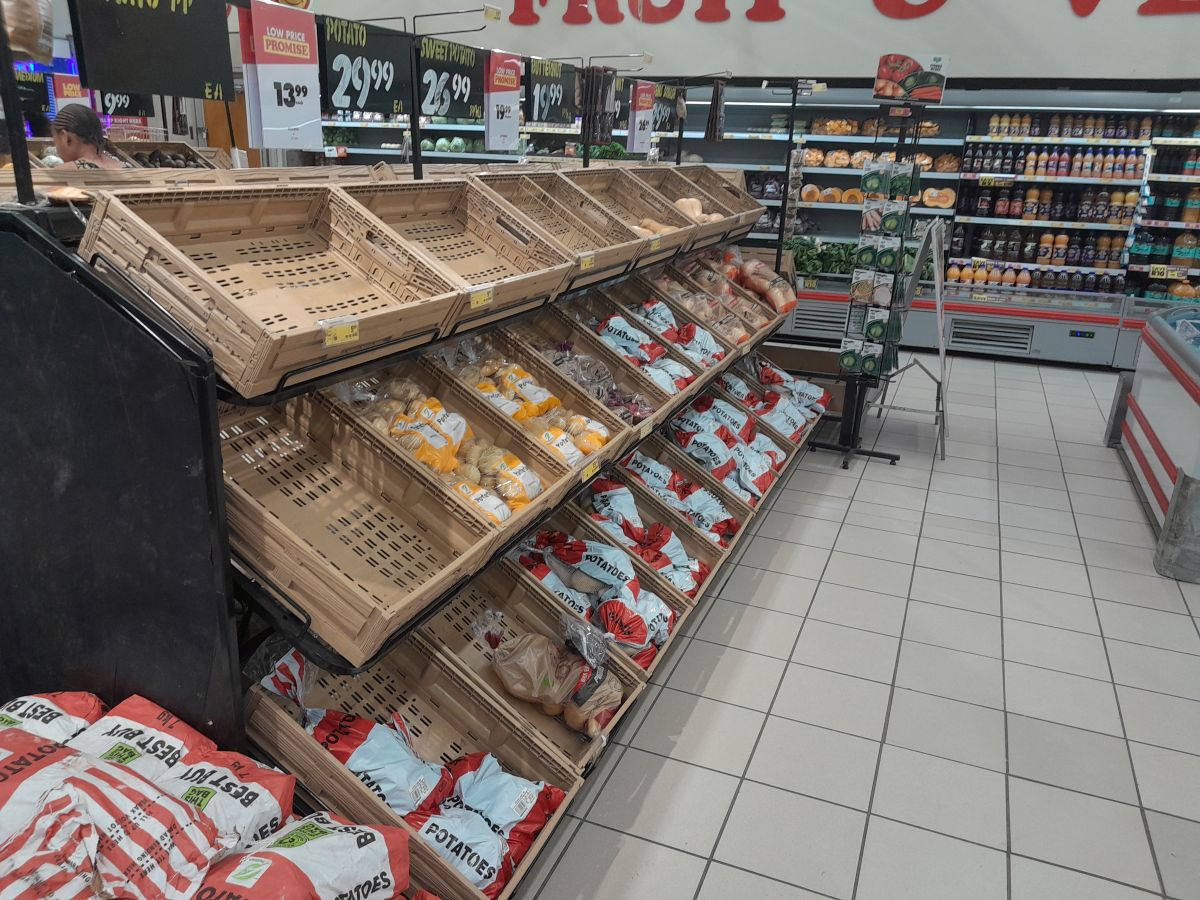
- Potatoes: Increased by 7% month-on-month.
- Beef: Rose by 5% month-on-month.
- Butternut: Increased by 8% month-on-month.
- Other Staples: Onions (+4%), brown bread (+2%), fish (+3%), and chicken gizzards (+3%) also recorded notable upticks.
Conversely, price drops in fresh produce and grains helped moderate the overall basket. Tomatoes (-18%), oranges (-17%), apples (-8%), carrots (-8%), cabbage (-6%), green peppers (-6%), and maize meal (-4%) all saw declines.
Regional data revealed a distinct geographic split. Food basket costs escalated in coastal and regional urban hubs including Pietermaritzburg (+R87,47), Durban (+R51,36), and Cape Town (+R26,99). In contrast, decreases were recorded in Mtubatuba (-R340,05), Mthatha (-R192,00), Springbok (-R174,79), and Johannesburg (-R108,67).
The official figures align broadly with broader economic indicators. Statistics South Africa’s Consumer Price Index (CPI) for July 2026 placed headline inflation at 4,3%, with CPI food and non-alcoholic beverages inflation tracking at -0,2% month-on-month and 0,9% year-on-year. Meanwhile, June Producer Price Index (PPI) data highlighted persistent pressures at the farm gate, with live animals and animal products running at 9,3% inflation.
The Minimum Wage Shortfall: Electricity and Transport Eat the Basket
The core issue facing South African workers is not merely retail price volatility, but the overwhelming burden of non-negotiable fixed costs.
The National Minimum Wage stands at R30,23 per hour, translating to a maximum monthly wage of R4 836,80 for a general worker working 20 days in August 2026. PMBEJD data underscores a harsh reality: for Black South African workers, a single wage supports an average of 4,1 family members. Disbursed across a family of four, the monthly per capita allocation sits at R1 209,20—well below the National Upper-Bound Poverty Line of R2 846 per month and the Lower-Bound Poverty Line of R1 415.
Crucially, food is bought only after basic transport and utility costs are settled. In August 2026, electricity (R1 263,45) and taxi transport (R1 920,00) consumed R3 183,45—or 65,8%—of a general worker’s full minimum wage earnings.
This leaves a worker with just R1 653,35 for all remaining monthly living expenses, including food:
- Required Nutritional Food Basket: The monthly cost to feed a family of four a basic, nutritionally adequate diet is R3 774,21.
- Worker Shortfall: Workers face a direct food deficit of 56,2% (a gap of R2 120,86).
- Per Capita Spending: Even if a worker dedicated every remaining cent (R1 653,35) entirely to food, a four-person household would survive on just R413,34 per person per month.
This allocation is 48% below the National Food Poverty Line of R855 per person per month—the threshold required to consume enough food to meet minimal daily energy requirements.

Grants Fail to Cover Child Nutrition
The crisis is equally pronounced for social grant recipients. In August 2026, the average monthly cost to feed a single child a basic nutritious diet was calculated at R961,96. Although this reflects a minor 1,9% decrease (-R18,70) month-on-month, it remains 2,0% (+R18,83) higher year-on-year.
The state Child Support Grant of R580 per month falls dramatically short:
- It is 32% below the National Food Poverty Line of R855 per month.
- It is 40% below the actual cost (R961,96) needed to secure proper child nutrition.
Nutritional Deficit and Hidden Hunger
To capture the true scope of the crisis, the PMBEJD compares its standard Household Food Basket—comprising lower-cost items households try to buy under extreme constraints—against a Basic Nutritional Food Basket designed by registered dieticians to ensure actual nutritional adequacy.
| Family Size | Aug 2025 | Jul 2026 | Aug 2026 | MoM Change (%) | YoY Change (%) |
| 4 Members | R3 699,35 | R3 848,97 | R3 774,21 | -1,9% | +2,0% |
| 5 Members | R4 864,47 | R4 674,97 | R4 771,59 | -1,9% | +2,1% |
| 7 Members | R6 727,47 | R6 460,93 | R6 597,25 | -1,9% | +2,1% |
For a standard larger family of seven members, the Basic Nutritional Food Basket costs R6 597,25 in August 2026. Comparing this to the standard Household Food Basket of R5 479,80 reveals a structural spending gap of R1 117,45.
Low-income households are effectively forced to underspend on basic nutritional requirements by a minimum of 17%. As families prioritize volume over nutritional quality to ward off hunger, micronutrient deficiencies and long-term health risks worsen.
While headline metrics show stabilization in agricultural pricing, South Africa’s low-income population remains trapped in a structural affordability crisis. Without intervention on energy tariffs, transport subsidies, or minimum wage alignments, minor drops in retail food prices will do little to alleviate widespread household insecurity.