
 By
By 
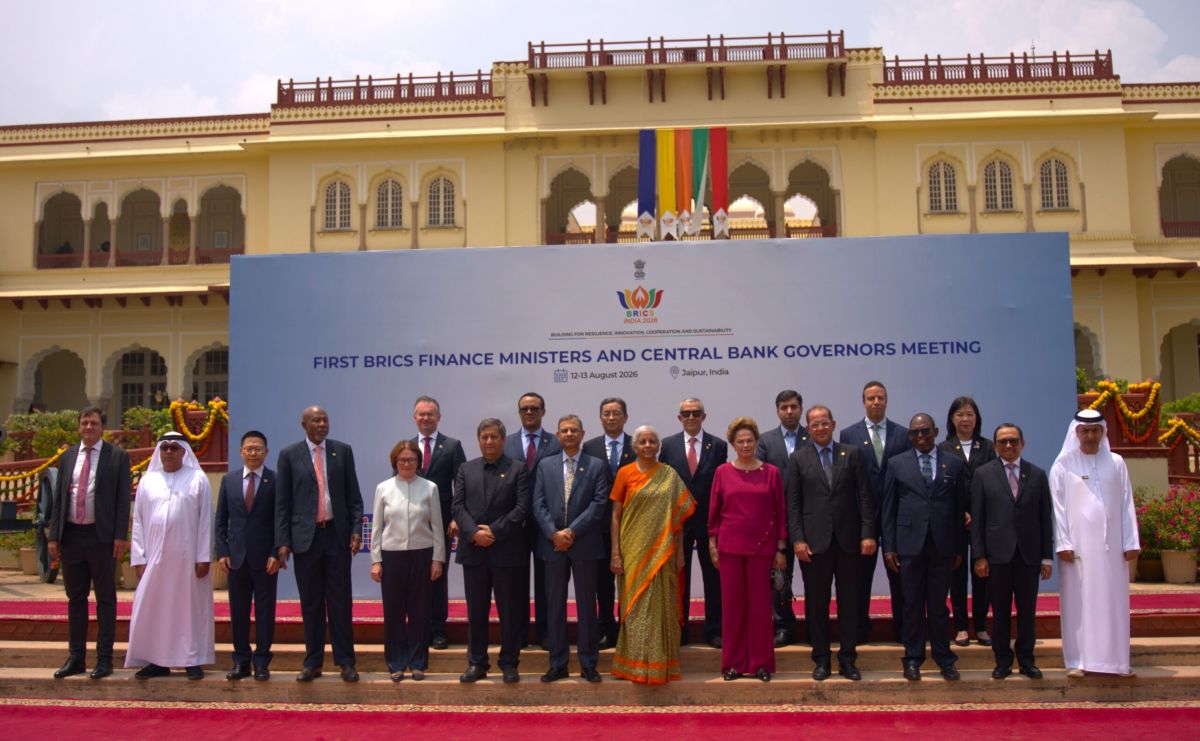
JAIPUR — As the growth engines of the global economy face increasingly complex financial realities, the challenge of funding large-scale infrastructure requires a fundamental shift in strategy.
Speaking at a high-level seminar on the sidelines of the BRICS Finance Ministers and Central Bank Governors (FMCBG) meeting in Jaipur, Union Minister for Finance & Corporate Affairs Smt. Nirmala Sitharaman delivered a clear message: public spending alone cannot sustain the world’s infrastructure demands; multilateral institutions must play a far stronger role in crowding in private investment.
The seminar, focused on “The Role of the New Development Bank in Mobilising Private Capital in Member Countries,” brought together key global policy and financial figures, including NDB President H.E. Ms. Dilma Rousseff, Department of Economic Affairs Secretary Smt. Anuradha Thakur, and FICCI Senior Vice President Mr. Vijay Sankar.
Public Capital as a Catalyst, Not a Replacement
At the core of the discussion was a pivotal economic reality facing BRICS economies—the structural constraints in scaling up private capital participation. Addressing policymakers, business leaders, and financial experts, Finance Minister Sitharaman emphasized that Multilateral Development Banks (MDBs), such as the New Development Bank (NDB), must act as risk-mitigating catalysts.
“Public capital must act as a catalyst — not a substitute for private investment,” FM Sitharaman noted, outlining India’s strategic approach to building national assets across highways, railways, logistics, digital networks, and energy sectors.
To bridge the transition from state-led spending to private sector engagement, India has deployed targeted policy instruments designed to balance risk and boost investor appetite:
- Viability Gap Funding (VGF): Provides capital support to financially constrained yet socially vital projects.
- Hybrid Annuity Model (HAM): Ensures balanced risk-sharing, particularly within road infrastructure.
- Infrastructure Investment Trusts (InvITs): Recycles existing capital to draw long-term institutional investment.
- Strategic Planning Frameworks: Frameworks like the National Infrastructure Pipeline and PM Gati Shakti offer long-term visibility and multimodal coordination to institutional investors.
Building on this structural baseline, the Union Budget 2026-27 further expands investment avenues with direct plays in logistics and transit, including new Dedicated Freight Corridors, High-Speed Rail Corridors, operationalized National Waterways, and the Coastal Cargo Promotion Scheme.
The Core Challenge: Creating Predictability at Scale
While emerging markets remain primary drivers of global growth, unlocking private investment requires overcoming systemic friction. As Minister Sitharaman highlighted, the central issue is rarely a sheer lack of capital, but rather the need for predictability, stability, and credible long-term frameworks that build institutional investor confidence.
Reiterating this structural view, DEA Secretary Smt. Anuradha Thakur pointed out that development finance has entered a crucial evolutionary phase where scale must be paired with institutional resilience. Capital mobilization cannot rely on ideal macro conditions; it requires durable frameworks built through cross-border multilateral cooperation.

A Collaborative Path Forward
The seminar concluded with an expert panel discussion exploring actionable de-risking mechanisms, bringing together leaders such as IRDAI Chairman Shri Ajay Seth, NDB Vice-President Mr. Roman Serov, Sertrading’s Mr. Alessandro Teixeira, Tencent Senior Advisor Mr. Yongping Zhai, and Mr. Pankaj Sindwani of the Tata Capital Decarbonisation Fund.
The consensus across Jaipur was clear: addressing global development needs demands true partnership. By combining the risk-mitigation capabilities of multilateral institutions, the regulatory foundation of national governments, and the scale of private market capital, the NDB and BRICS member states can create an enduring ecosystem for sustainable economic growth.