
 By
By 
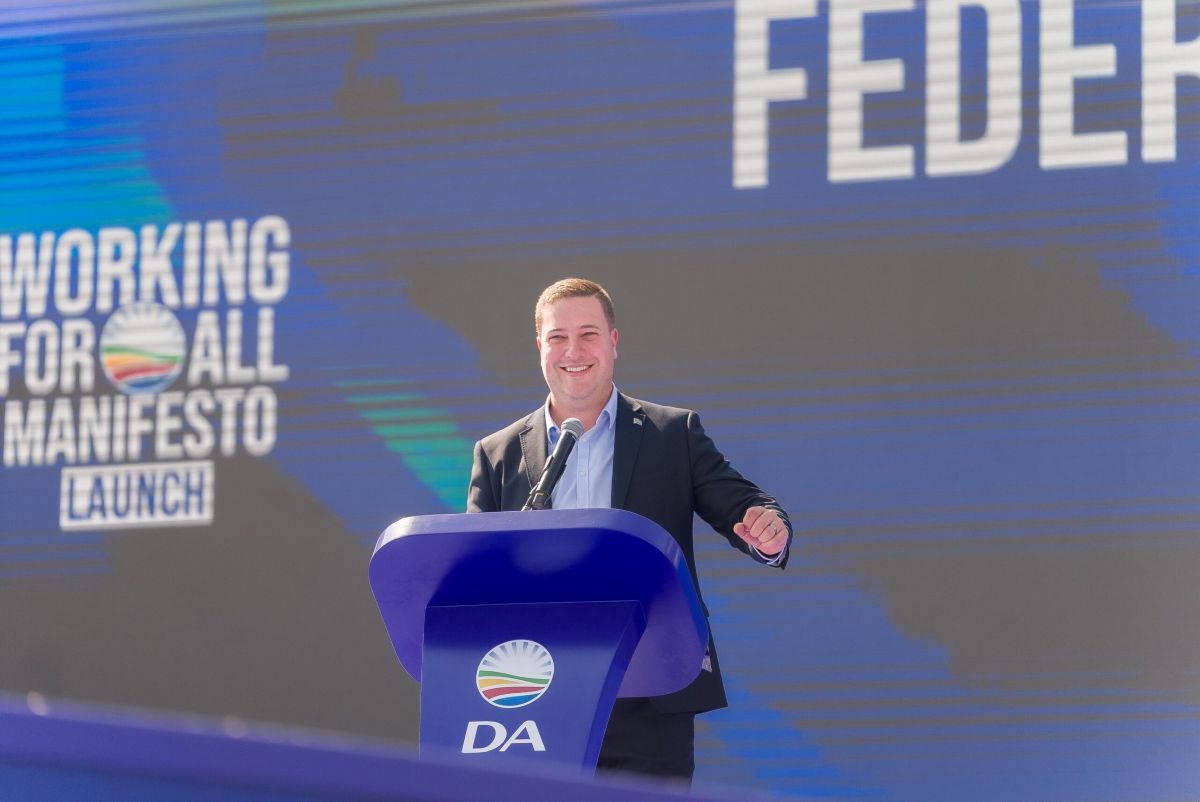
JOHANNESBURG — Standing before a crowd of supporters at Mary Fitzgerald Square in Johannesburg on Saturday, August 8, 2026, Democratic Alliance (DA) Leader Geordin Hill-Lewis officially launched the party’s local government manifesto with a message centred on restoring fundamental governance and basic service delivery.
Framing the upcoming municipal elections not around high-minded political rhetoric but around the daily realities of citizens, Hill-Lewis declared that across South Africa, an “ordinary life has become an extraordinary privilege”.
“Politics is full of grand promises,” Hill-Lewis told the gathering, directly addressing what he characterized as a growing cynicism among voters. “South Africans have heard enough promises. What they now need is a government that works. Our pledge to you is that we will show up every morning and fix what has been broken”.
The manifesto launch comes at a crucial juncture ahead of the November 4 election, as municipalities across the country struggle with severe infrastructure decay, water supply disruptions, persistent power instability, and rising crime.
Redefining “Ordinary” Governance
The central premise of the DA leader’s address focused on demystifying what citizens ought to expect from municipal administration. According to Hill-Lewis, voters are not demanding extravagant political projects; rather, their expectations are grounded in fundamental civic needs.
“They want to open a tap and get water,” Hill-Lewis said. “They want to push the light switch and get light. They want to walk home safely under a working streetlight. They want their rubbish collected. They want the pothole fixed before it cuts another tyre”.
He argued that when local government functions correctly, it should be unobtrusive. “Your municipality should be the least dramatic part of your day,” he stated, outlining scenarios currently faced by South Africans: mothers waking before sunrise to find dry taps, small business owners unable to operate due to power outages, and residents navigating unlit, dangerous streets.
Hill-Lewis warned against what he described as the “creeping belief that decline is inevitable and irreversible,” urging South Africans not to lower their expectations or adapt to municipal dysfunction. “You are not a subject who must beg a politician for a favour,” he said. “You are a citizen. You pay for government. You elect government. And you have every right to demand that government works for you”.
Three Key Guarantees to Voters
To address systemic local governance failures, the DA leader outlined three core promises anchor the party’s election campaign:
1. A Government You Can Trust
Hill-Lewis pledged an immediate end to “cadre deployment” in DA-governed municipalities, committing to professionalizing administrative ranks. Under this pledge, municipal appointments would strictly follow merit and qualification rather than political connections.
- Professional Management: Qualified engineers must manage technical infrastructure, while honest professionals lead city administrations.
- Anti-Corruption Measures: Implementing zero tolerance for corruption, transparent procurement processes, and overhauled municipal billing systems to ensure public money is strictly accounted for.
2. Services You Can Rely On
A key policy announcement delivered at Mary Fitzgerald Square was a strict revenue-protection rule for utilities. Under DA governance, every rand collected for water services will be ring-fenced exclusively for water infrastructure maintenance and repairs, and every rand collected for electricity will be dedicated solely to maintaining power grids and substations.
- Preventing Misallocation: Municipal utility revenue will no longer be used as a political “slush fund” or diverted to inflated salaries and corrupt contracts.
- Technology & Public Spaces: Using advanced technology to detect leaks and infrastructure faults before catastrophic failures occur, alongside public-private partnerships to restore neglected parks, clinics, libraries, and sports fields across all neighborhoods.
3. A Community in Which You Can Get Ahead
Focusing on economic enablement and safety, Hill-Lewis argued that functional cities directly fuel investment, local business growth, and employment.
- Cutting Red Tape: Streamlining permit processes and lowering costs for micro-entrepreneurs and informal traders, establishing serviced, safe trading zones.
- Devolved Crime-Fighting: Demanding expanded policing powers for capable municipalities. Hill-Lewis called for municipal police forces to have full investigative authority so that arrests translate into solid evidence and court convictions, targeting crime hotspots and extortion syndicates directly at the community level.
A Tale of Three Municipalities
To demonstrate the practical difference between governance models, Hill-Lewis pointed to a recent visit to Savannah City in the Midvaal Local Municipality. Standing on a newly constructed sports facility featuring netball courts, a soccer pitch, and an indoor sports hall, he highlighted the stark contrast visible from a single vantage point.
“From one soccer pitch, you could see the consequences of bad government and the possibilities of good government, side by side,” Hill-Lewis remarked, citing the adjacent City of Johannesburg metro and Emfuleni municipality as examples of severe administrative breakdown compared to the high-performing DA-led Midvaal.

He cited other DA-governed areas, such as Kouga, Swartland, Saldanha Bay, and Cape Town, as evidence that municipal service delivery is attainable through clean, disciplined financial management. Addressing inclusivity, Hill-Lewis shared an interaction with a Johannesburg businessman whose family resides in Gugulethu, Cape Town, pointing to ongoing sewer and road upgrades in the area as evidence that DA governance benefits all communities regardless of political background.
The Road to November 4
Concluding his address, Hill-Lewis highlighted the marginal differences that often decide local elections, referencing Ward 28 in Emfuleni, where the DA recently won by just eight votes. He reminded the crowd that electoral outcomes directly dictate whether a municipality experiences continued decline or administrative recovery.
“On November 4th, vote for your taps to run. Vote for your streetlights to shine. Vote for your bins to be emptied. Vote for the criminal to be caught and convicted,” Hill-Lewis urged. “We will fix what is broken. We will restore hope. We love our country, and we will build a South Africa that works, for everyone”.