
 By
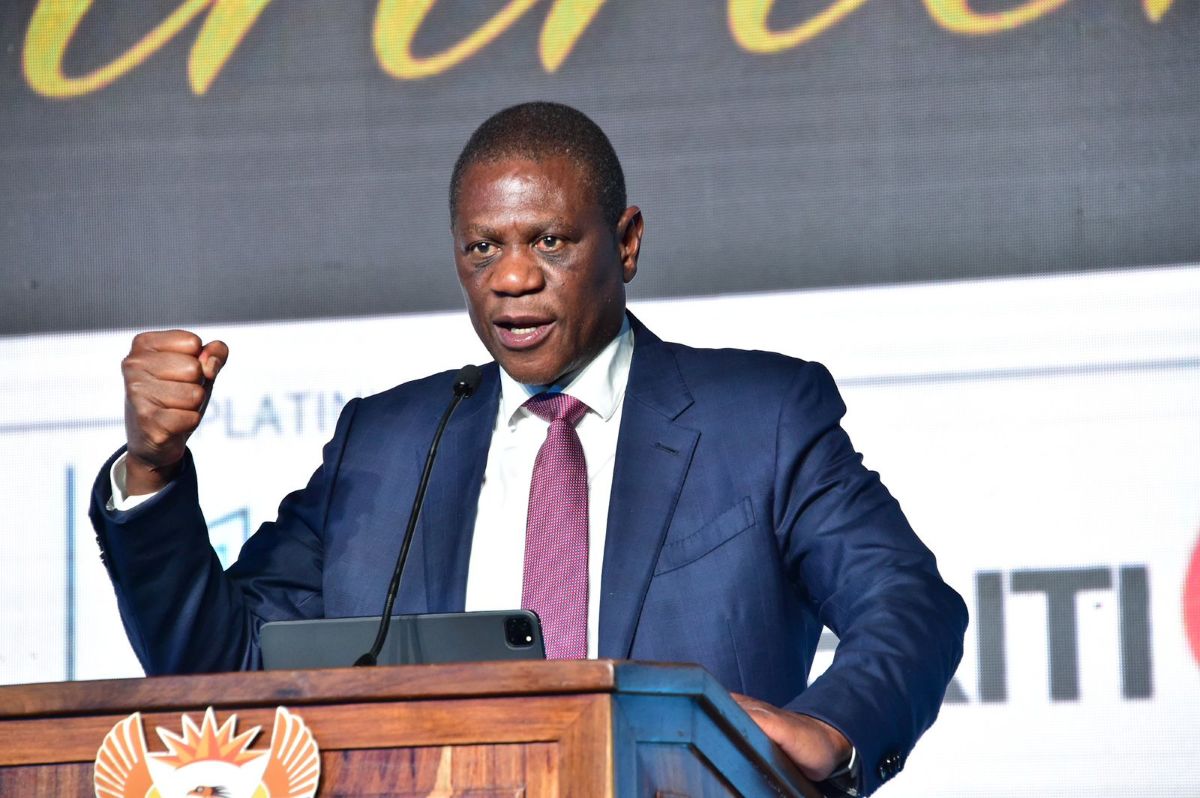
JOHANNESBURG – Africa’s private sector must move beyond merely consuming foreign technologies and position itself as a global exporter of home-grown Artificial Intelligence (AI) solutions, Acting President Shipokosa Paulus Mashatile told continental business executives and policymakers on Thursday evening.
Delivering the keynote address at the All-Africa Business Leaders’ Awards (AABLA) at the Sandton Convention Centre, Mashatile—speaking remotely on behalf of President Cyril Ramaphosa—framed the current technological shift as a decisive inflection point for the continent’s economic trajectory.
Addressing an audience that included World Trade Organization (WTO) Director-General Dr Ngozi Okonjo-Iweala, ABN Group co-founder Rakesh Wahi, and CNBC Africa and Forbes Africa Vice-Chairman Sid Wahi, the Acting President argued that while Africa boasts some of the world’s fastest-growing economies, macroeconomic expansion continues to be undercut by persistent poverty, inequality, and severe infrastructure deficits.
“The question is no longer whether Africa has potential, but whether we have the collective vision, determination and political will to translate that potential into prosperity,” Mashatile said.
Central to that translation, he noted, is how aggressively African enterprises adopt and build upon emerging technologies. Describing AI as one of the most transformative forces reshaping the global economy, Mashatile warned that passive adoption would leave the continent behind.
“We cannot afford to remain consumers of technologies developed elsewhere,” he stated. “We must become innovators, builders and exporters of AI solutions that respond to African realities and compete globally.”
He urged executives to prioritise capital allocation toward AI, digital infrastructure, and research and development, noting that the investment decisions made today will dictate corporate competitiveness and job creation in the coming decades.
However, Mashatile cautioned that capital expenditure on technology will fail to yield systemic transformation without parallel investments in human capital. Pointing to demographic projections, he highlighted that Africa’s youth population is expected to surpass 830 million by 2050, by which time the continent will account for roughly 85 per cent of global workforce growth.
Converting this demographic surge into an economic dividend rather than a socio-economic liability requires urgent alignment between corporate strategy and education. Mashatile called on both public and private stakeholders to prioritise digital literacy, entrepreneurship, and science, technology, engineering, and mathematics (STEM) to prepare young Africans to lead—rather than merely participate in—the future economy.
Beyond digital transformation, the Acting President underscored the physical and regulatory bottlenecks stifling intra-African commerce. Turning to the African Continental Free Trade Area (AfCFTA), Mashatile described the pact not merely as a tariff-reduction mechanism, but as a foundational continental development project aimed at consolidating 54 fragmented economies into a single market of over 1.4 billion people with a combined gross domestic product exceeding US$3.4 trillion.
Citing World Bank projections, he noted that full implementation of the AfCFTA could boost intra-African exports by more than 80 per cent by 2035 and lift millions out of extreme poverty. Yet, policy frameworks alone cannot overcome logistical friction.
“It should not be easier, faster or cheaper to trade with markets outside our continent than with our neighbours,” Mashatile said, calling for accelerated investment in modern transport corridors, efficient ports, reliable energy grids, and cross-border broadband connectivity to lower the cost of doing business and strengthen regional value chains.
Reflecting on the broader role of the private sector in achieving the African Union’s Agenda 2063, Mashatile dismissed the notion that state intervention alone can drive industrialization and economic integration.
Recalling a question posed to him after addressing the same forum in 2023 regarding why senior government leaders attend corporate awards ceremonies, he emphasized that state recognition of private enterprise is an acknowledgment of risk-taking and job creation.
“Africa’s development cannot be driven by Governments alone,” he told the finalists and industry leaders. “It requires strong public-private partnerships” and executives willing to look beyond short-term shareholder returns to expand into new regional markets.
Concluding his remarks, Mashatile commended the evening’s nominees and winners for driving enterprise across the continent, urging them to continue scaling across borders and mentoring the next generation of African entrepreneurs