 By
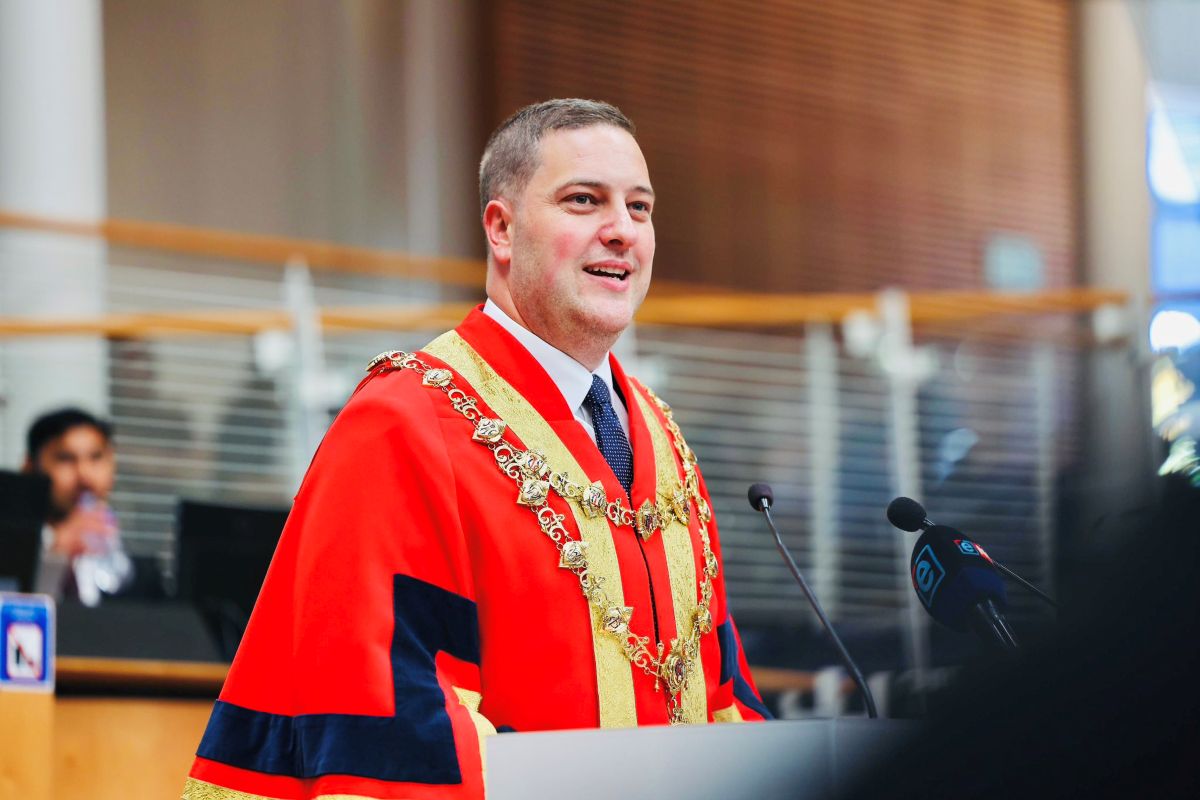
CAPE TOWN — Geordin Hill-Lewis formally began his second term as Executive Mayor of Cape Town on Thursday, framing the Democratic Alliance’s (DA) retention of an outright council majority as both a political anomaly in South Africa’s fractured urban landscape and a mandate to accelerate service delivery in historically underserved townships.
Delivering his inaugural address to the newly constituted 2026–2031 council, Hill-Lewis—who also serves as leader of the DA—contrasted Cape Town’s political stability with the coalition negotiations currently unfolding across the country’s other seven metropolitan municipalities following the 4 November local government elections.
“Consider that twenty years ago Cape Town was the only city in the country without a majority government, and the other seven metros held what seemed like unassailable majorities,” Hill-Lewis told the chamber. “Now the tables have turned. Cape Town is the only metro with an outright majority, while all seven others require coalitions.”
Breakthrough in Township Voting Blocs
A central theme of the mayor’s address was the shifting electoral geography within the metro itself. While the DA had warned voters ahead of the polls about the risks of “coalition chaos”, Hill-Lewis credited the party’s renewed mandate to significant inroads made in Cape Town’s largest townships.
According to the mayor, tens of thousands of residents in Khayelitsha, Gugulethu, Langa, Nyanga, Philippi, Crossroads, and Mfuleni cast their ballots for the DA for the first time. He characterized the shift as evidence that South African voters are moving beyond historic political alignments in favour of tangible municipal performance.
“It means that political choices need no longer be bound by the divisions of our past,” Hill-Lewis said, adding that the results represented both “a vote of confidence” and “a vote of expectation” regarding infrastructure investment and basic services.
Five Pledges for the 2026–2031 Term
Outlining his administration’s policy priorities for the next five years, Hill-Lewis anchored his programme on five core commitments:
- Municipal Policing and Investigative Powers: Citing an inability to rely on the South African Police Service (SAPS) to guarantee safety, Hill-Lewis announced plans to recruit, train, and deploy a dedicated City detective unit during this term. He reiterated his administration’s ongoing push to secure formal investigative powers for municipal officers alongside expanded investments in safety technology.
- Job Creation and Economic Growth: Pointing to figures showing that 420,000 people moved out of unemployment in Cape Town over the previous five-year term—a figure he noted matched the job creation of all other South African cities combined—Hill-Lewis pledged to maintain an investment-friendly regulatory environment aimed at repeating that growth.
- Basic Services and Infrastructure: Following heavy capital expenditure on water, sanitation, electricity grids, and roads, the mayor promised continued focus on eliminating sewer blockages and spills. He cited recent full-street sewer replacements in Langa as the standard his administration intends to replicate across the metro.
- Affordable Housing and Land Release: Acknowledging that rapid inward migration places acute pressure on housing stock, Hill-Lewis committed to accelerating social and affordable housing projects, upgrading informal settlements, and releasing additional city-owned land for development.
- Cleaner Public Spaces: Emphasising civic pride, the mayor called for stricter enforcement and community participation to curb littering and illegal dumping across parks, beaches, rivers, and streets.
Tone Toward the Opposition and National Ambitions
While asserting a clear governing mandate, Hill-Lewis struck a conciliatory tone toward opposition benches, specifically welcoming Leader of the Opposition Cllr Lwazi Phakade and newly elected councillors. He stated that no single party holds a “monopoly on truth” and pledged cooperation with opposition members and civil society groups on constructive proposals.
Beyond municipal boundaries, the speech underscored the broader national stakes for the DA leader as coalition talks elsewhere hit deadlocks. Hill-Lewis positioned Cape Town as a proof-of-concept for governance in South Africa, arguing that the city’s trajectory disproves narratives of inevitable national decline.
“Our ambition must never be to remain the only city in South Africa that works,” Hill-Lewis concluded. “It must be to help inspire a country of cities that work.”