
 By
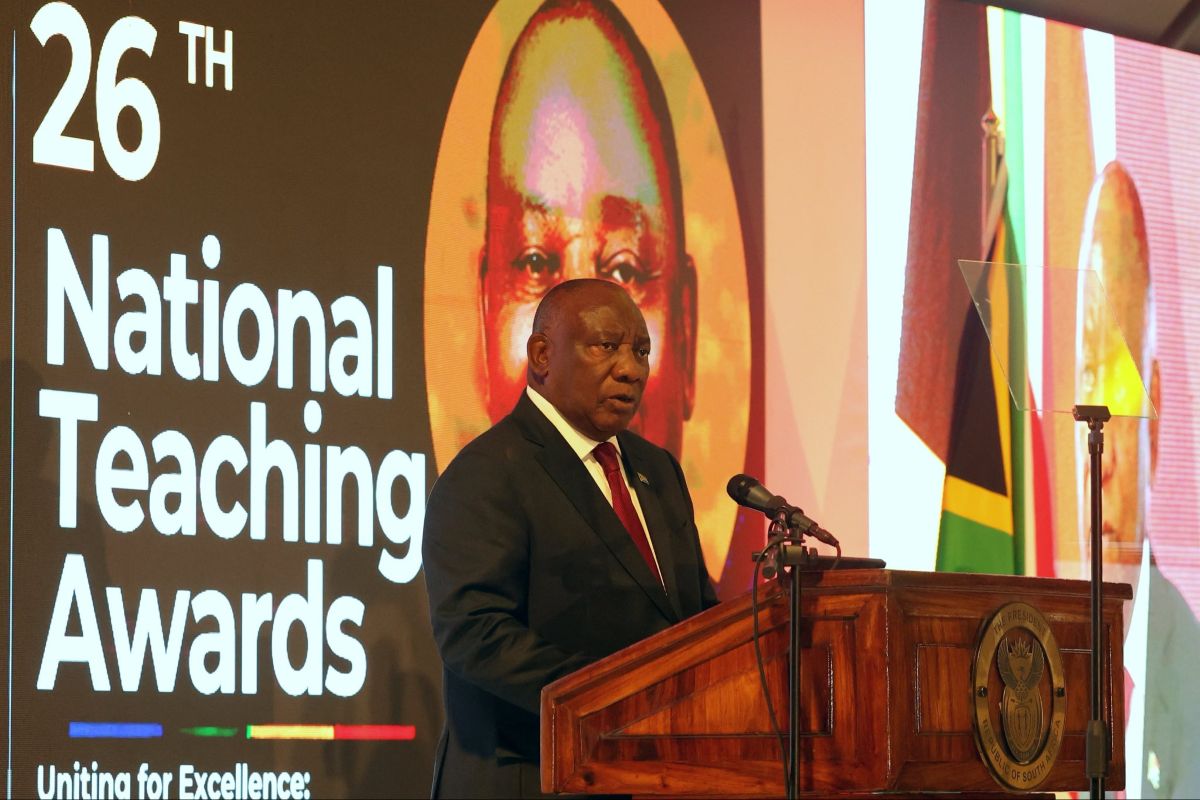
By EKURHULENI — Standing before a rapt audience of educators, policymakers, and community leaders at the Birchwood Hotel and Conference Centre on Thursday, President Cyril Ramaphosa offered a deeply personal reflection that set the tone for the 26th National Teaching Awards.

Recalling his own school days as an inquisitive learner whose questions nearly landed him an expulsion, the President paid tribute to his late principal, Mr Ntsandeni—a man who chose guidance over punishment, recognizing promise where others saw defiance.
“I have often wondered how different my life might have been had he not intervened,” President Ramaphosa shared. “He did more than keep me in school. He gave me the opportunity to continue learning, to develop and to become the person I am today.”
This sentiment of profound gratitude anchored an event designed to honour more than 133 national finalists representing the pinnacle of pedagogical excellence across South Africa. Held just days ahead of World Teachers’ Day on October 5, the ceremony served as both a celebration of resilience and a sobering reminder of the systemic challenges facing the nation’s classrooms.
A Shared Endeavour for Excellence
Running under the theme “Uniting for Excellence: Elevating Achievement, Empowering Educators to Shape South Africa’s Future,” the 26th edition of the awards highlighted that educational triumph transcends demographic and geographic boundaries. From under-resourced rural schools in Limpopo to township institutions navigating complex socio-economic hurdles and elite urban campuses, excellence thrives wherever dedicated teachers refuse to lower their expectations.
However, the President was quick to emphasize that pedagogical success cannot occur in a vacuum. “No teacher succeeds alone,” Ramaphosa stated, pointing to the essential ecosystem required to foster learning: principals who protect instructional time, district officials providing meaningful support, provincial departments delivering learning materials timeously, and communities actively engaged in early childhood education.
In a direct nod to the administrative and structural hurdles encumbering the profession, the government acknowledged its own imperative obligations. Ramaphosa pledged renewed commitments to reduce administrative burdens, improve school infrastructure, tackle overcrowding, and enforce zero-tolerance policies against violence and disruptions in schools.
“We must create the conditions in which teachers are able to do what they entered the profession to do: to teach.”
Honouring Legacies and Rising Stars
The ceremony also paid homage to the enduring legacy of late Education Minister Professor Kader Asmal, who launched the National Teaching Awards in 2000 as a vehicle for social transformation. The prestigious Kader Asmal Lifetime Achievement Award was presented to an educator who has dedicated decades to shaping South Africa’s youth, embodying Asmal’s vision of intellectual rigour and educational equity.
Adding an international dimension of pride to the proceedings, Ramaphosa congratulated Basic Education Minister Siviwe Gwarube on her recent inclusion in the TIME100 Next list of the world’s most influential rising stars. Framing the recognition as both an honour and a challenge, the President urged leadership to turn global acclaim into measurable classroom progress.
Navigating the Digital Age and Historic Milestones
As the education sector confronts rapid technological disruption, the address struck a careful balance regarding artificial intelligence and digital tools. While acknowledging AI’s immense potential to assist with lesson planning and differentiated learning, Ramaphosa issued a cautionary note regarding misinformation.
“Artificial intelligence may be able to provide an answer, but a teacher helps a learner understand the question,” he remarked, underscoring that algorithms cannot replicate human empathy, discipline, and moral guidance.
This moral imperative resonated deeply as the nation marked the 50th anniversary of the 1976 Soweto uprising. Remembering the educators who kept the flame of learning alive during the dark days of Bantu Education—often at great personal peril—Ramaphosa drew a direct line from past struggles to modern societal crises, particularly gender-based violence and femicide.
Calling schools frontline spaces for prevention, the President stressed that education must actively cultivate respect, consent, and equality among boys and young men. “Every school must be a place of safety,” he declared. “Every educator must uphold the highest standards of professional conduct.”
A Call to Action for the Class of 2026
As the ceremony drew to a close, the focus shifted sharply to the immediate horizon: the upcoming final examinations. Directing his final remarks to the Class of 2026, Ramaphosa urged learners to maximize their remaining weeks, lean on one another, and trust the guidance of their teachers.
For the nation’s educators, the message was clear and resounding. Despite systemic pressures, resource constraints, and societal expectations, the classroom remains the crucible where South Africa’s future is forged. Through every child who learns to read for meaning and every teacher who refuses to give up, the promise of a transformed nation takes root.