
 By
By Introduction: Dismantling the “Poisoned Chalice”
When Dr. Leon Schreiber took office as South Africa’s Minister of Home Affairs twenty-seven months ago under the Seventh Administration’s Government of National Unity (GNU), the department was universally viewed as a “poisoned chalice”.

Famously dubbed “Hell Affairs” by the public, the department was defined by endless queues, paper-based submissions arriving in house-moving cardboard boxes, and a staggering backlog of over 306,000 visa applications.
On Thursday, speaking at the Home Affairs Quantum Leap address at Constitution Hill, Minister Schreiber painted the picture of a department undergoing an unprecedented, rapid revolution—pivoting from a broken, centralized analog model to a modern, decentralized digital powerhouse.
Key Pillars of the Home Affairs Quantum Leap
1. The Death of the Green ID Book and Bank Branch Expansion
The days of standing in lines for hours at traditional Home Affairs offices are rapidly coming to an end. Through a strategic partnership with the banking sector, the department has more than tripled access to Smart ID replacement services.
- Over 515 bank branches now offer biometrically-based digital services where citizens can walk in without an appointment to get a replacement Smart ID in just five minutes.
- Access is expanding toward more than 1,000 service points by the end of 2026, marking a near-five-fold increase.
- In a massive policy shift, the department will permanently cease production of the fraud-prone Green ID book by March 31, 2027, completely decommissioning the production machines.
- Citizens will have until March 31, 2028, to transition, after which the Green ID book will officially cease to be recognized as a valid form of identification.
2. Revolutionizing Travel and Immigration with the ETA
Tourism and economic growth are receiving a massive boost through the new Electronic Travel Authorisation (ETA) platform.
- Powered by advanced biometrics and machine learning, the ETA has cut visa processing times for short-stay travellers from weeks down to just 24 hours.
- Initially launched for 53 countries, the platform is expanding to include study and work visas in early 2027, drastically reducing human error and corruption risks.
- Looking forward, the Border Management Authority (BMA) is preparing to introduce automated gates and gantries at all ports of entry, anchored by the reality that “you cannot bribe a computer”.
3. Pioneering South Africa’s First Digital ID
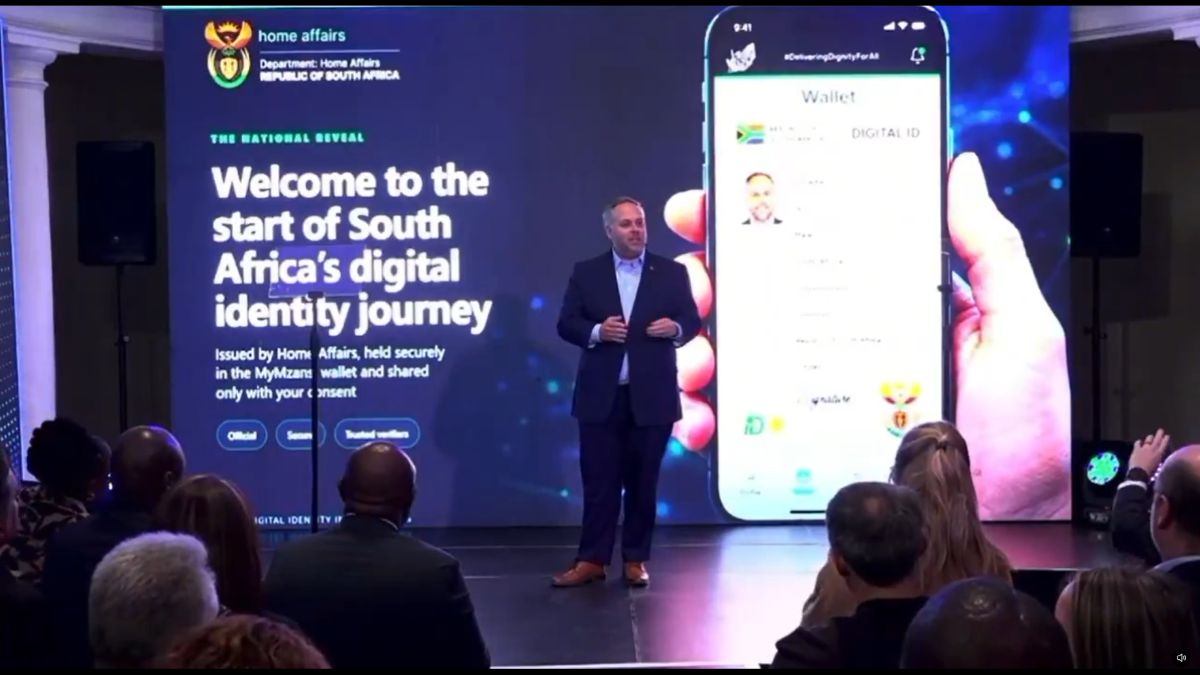
Minister Schreiber provided a historic moment during his address by showcasing a live demonstration of South Africa’s first-ever official Digital Identity credential, making him the first citizen to utilize a working digital ID bound to a smartphone chip.
- The voluntary system will act as a digital counterpart to the physical Smart ID card.
- Built with strict data limits, the system prioritizes transparency, allowing citizens to monitor every instance their data is accessed.
- The long-term vision eliminates standard application cycles entirely: citizens will receive automated renewal notifications via their smartphone wallet months before a passport expires, with the new document delivered directly to their doorstep.
Restoring Dignity: Documenting Every South African
Perhaps the most profound capstone of the department’s turnaround is its renewed focus on the millions of citizens who remain undocumented 32 years into democracy. Because digital automation is clearing out routine ID and passport queues, Home Affairs is redirecting its capacity toward a massive historic campaign during the 2028/29 financial year.
Utilizing mobile biometric technology, the department intends to physically visit communities across the country to ensure that every single South African citizen is formally documented for the first time in history.
Conclusion: A New Blueprint for Government
Minister Schreiber’s address serves as proof that even the most bogged-down public sector entities can be radically restructured within a single term of government. By embracing public-private partnerships, aggressive automation, and a culture of accountability—highlighted by 144 dismissals, 73 arrests, and 10 convictions since July 2024—Home Affairs is no longer just fixing its own infrastructure. It is setting a new technological benchmark for the entire South African state.